
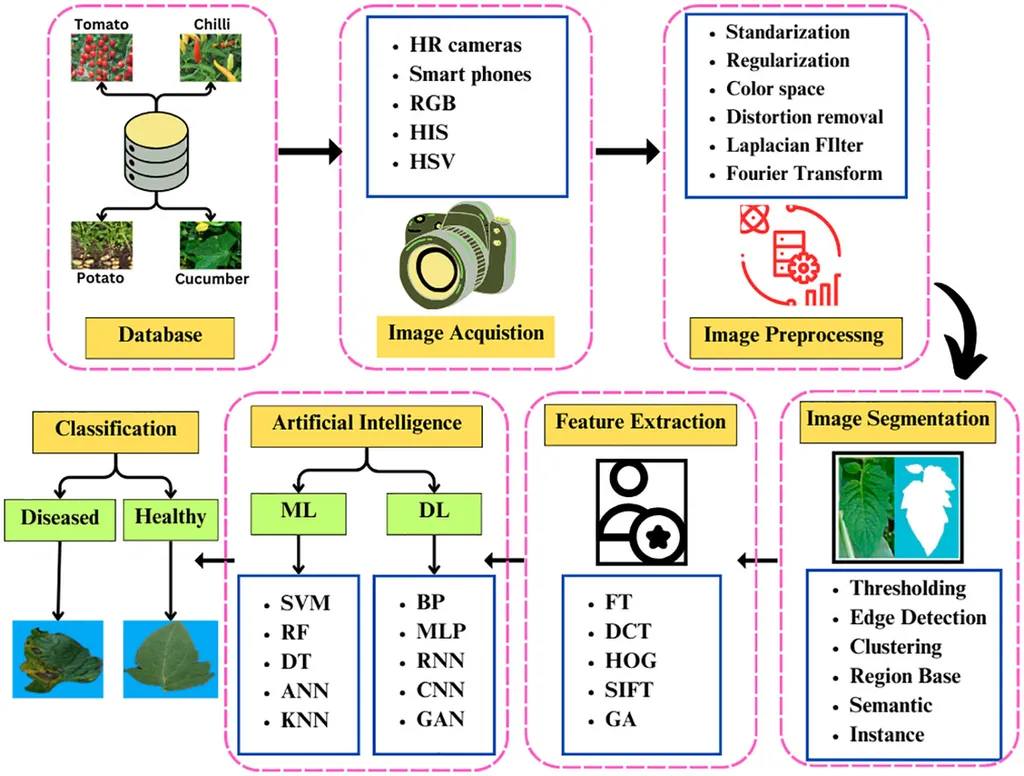
In the face of mounting climate and ecological challenges, the agriculture sector is turning to technology to bolster sustainable practices. A recent study published in *Discover Applied Sciences* introduces an enhanced MobileNet-V2 model designed to revolutionize the identification of rice diseases and pests, offering a promising solution for farmers worldwide. The research, led by Yu Zhang from the Beihai Campus of Guilin University of Electronic Technology, presents a model that not only improves diagnostic accuracy but also supports real-time, on-device analysis, a critical need for modern, eco-friendly farming.
The enhanced MobileNet-V2 model integrates several innovative components to tackle the complexities of field imagery. “Field images often contain tiny lesions, motion blur, and cluttered backgrounds, which pose significant challenges for lightweight models intended for edge deployment,” explains Zhang. To address these issues, the model incorporates a lightweight Super-Resolution (SR) front-end that restores fine textures in low-quality inputs, an Adaptive Selective Attention Module (ASAM) that combines channel and spatial cues at multiple depths to highlight discriminative regions, and a Cross-Level Feature Fusion Module (CLFFM) that fuses shallow details with deep semantics to strengthen small-object perception under clutter.
The results are impressive. The model achieves 94.3% accuracy and a 0.938 F1-score, surpassing mainstream Convolutional Neural Network (CNN) baselines while remaining compact (9.7 MB) and fast (11.2 ms/image). This balance of accuracy and efficiency supports real-time, on-device diagnosis, reducing the need for pesticides and minimizing the environmental burden.
The commercial implications for the agriculture sector are substantial. Accurate and timely identification of rice diseases and pests can lead to more targeted and effective treatments, reducing the reliance on broad-spectrum pesticides that can harm beneficial insects and the environment. This precision agriculture approach not only improves crop yields but also promotes sustainable farming practices, aligning with global efforts to reduce agricultural environmental impact.
The enhanced MobileNet-V2 model’s success in rice pest and disease recognition opens up new possibilities for similar applications in other crops. As Zhang notes, “The model’s ability to handle low-quality images and its efficiency make it a versatile tool that can be adapted for various agricultural needs.” This adaptability could drive further innovation in the field, leading to more robust and efficient diagnostic tools for farmers.
The research also highlights the importance of integrating advanced technologies like attention mechanisms and cross-level feature fusion into lightweight models. These innovations pave the way for more sophisticated and efficient diagnostic tools that can operate on edge devices, making them accessible to farmers in diverse agricultural settings.
In conclusion, the enhanced MobileNet-V2 model represents a significant step forward in the quest for sustainable agriculture. Its ability to provide accurate, real-time diagnostics supports more efficient and environmentally friendly farming practices, offering a blueprint for future developments in the field. As the agriculture sector continues to grapple with climate and ecological pressures, such technological advancements will be crucial in promoting green and efficient farming practices.