
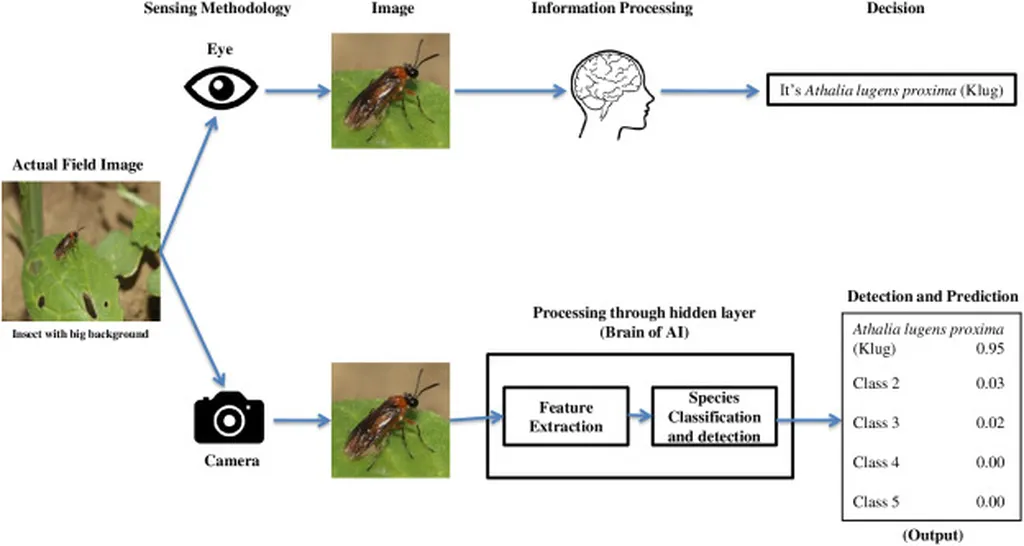
In the relentless battle against insect pests, farmers and agronomists have long relied on manual inspection and expert analysis. These methods, while effective, are labor-intensive and often too slow to prevent significant crop damage. Enter Attention-PestNet, a groundbreaking one-stage object detection network designed to revolutionize insect pest detection in agriculture. This innovative technology, detailed in a recent study published in *Plant Methods*, promises to enhance precision and scalability in pest monitoring, offering a much-needed boost to modern precision agriculture.
At the heart of Attention-PestNet are two key attention-based modules that set it apart from traditional detection methods. The Hierarchical Scaled Dot-Product Attention module captures salient pest features at different scales, while the Multi-Scale Spatial Attention module refines spatial feature representations by incorporating horizontal and vertical attention pathways. These modules work together to improve detection accuracy and efficiency, addressing the challenges posed by the high visual similarity between pest species and intra-species variability across developmental stages.
The lead author of the study, Vu Thinh Doan from the Intelligent System Laboratory at the National Kaohsiung University of Science and Technology, emphasizes the significance of this research. “Our method leverages advanced attention mechanisms to enhance feature extraction and improve detection performance,” Doan explains. “This not only makes pest detection more accurate but also more scalable, which is crucial for resource-constrained settings.”
The potential commercial impacts of Attention-PestNet on the agriculture sector are substantial. By enabling timely and precise pest detection, farmers can implement targeted interventions, reducing crop losses and minimizing the use of pesticides. This not only improves yield and profitability but also promotes more sustainable farming practices. The technology’s scalability means it can be deployed across large agricultural areas, making it a valuable tool for both small-scale farmers and large agribusinesses.
Extensive experiments conducted on two public benchmarks, the IP102 and R2000 datasets, demonstrate that Attention-PestNet outperforms state-of-the-art models in both visualization outputs and quantitative metrics. These results highlight the technology’s strong potential as a scalable and cost-effective solution for intelligent pest monitoring.
As the agriculture sector continues to embrace precision farming, technologies like Attention-PestNet are poised to play a pivotal role. By integrating advanced machine learning techniques with agricultural practices, we can enhance crop protection, improve resource management, and ultimately contribute to global food security. The research conducted by Vu Thinh Doan and his team represents a significant step forward in this direction, offering a glimpse into the future of intelligent pest monitoring in modern agriculture.