
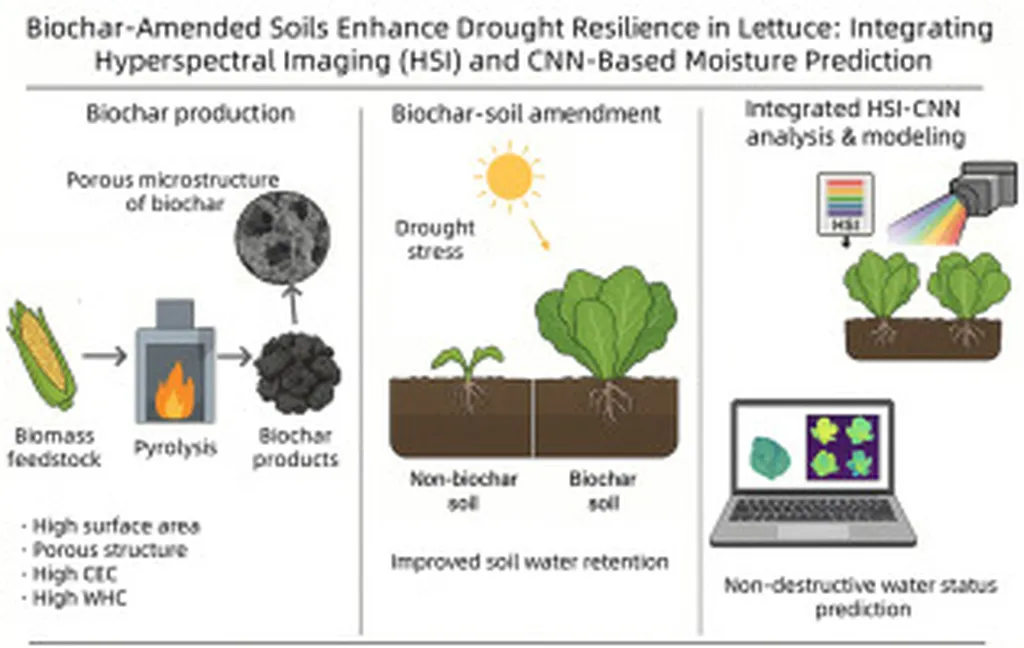
In the face of escalating drought conditions, farmers are constantly seeking innovative strategies to safeguard their crops and maintain yields. A recent study published in the *Journal of Agriculture and Food Research* offers a promising solution by combining biochar soil amendments with advanced hyperspectral imaging (HSI) and machine learning techniques to enhance drought resilience in lettuce. The research, led by Ruogu Tang from the Department of Animal and Food Sciences at the University of Delaware, presents a novel approach that could revolutionize precision agriculture and climate-resilient farming practices.
Biochar, a carbon-rich product derived from the pyrolysis of organic materials, has long been recognized for its ability to improve soil health and water retention. However, traditional methods of evaluating its effectiveness have been time-consuming and destructive. Tang and her team sought to overcome these limitations by integrating biochar amendments with cutting-edge technology. “We wanted to develop a rapid, non-destructive method to assess drought resilience in crops,” Tang explains. “By combining biochar with hyperspectral imaging and convolutional neural networks (CNN), we were able to create a scalable, high-throughput tool for real-time crop water monitoring.”
The study focused on corn-stalk-derived biochars produced at different temperatures (350°C, 550°C, and 700°C) and applied at varying concentrations (1%, 3%, and 5% by weight) to lettuce plants under well-watered and water-stressed conditions. The results were impressive. Highly pyrolyzed biochars (CSB550 and CSB700) at 5% concentration increased fresh biomass by 33.2%, plant height by 29.8%, and leaf moisture content by 5.63% compared to the drought-stressed control without biochar amendment. Additionally, soil moisture retention improved by up to 24%.
But the real innovation lies in the integration of HSI and CNN modeling. Hyperspectral imaging captures rich spectral signatures from plant canopies, while CNN models can interpret these complex, non-linear relationships to predict plant moisture content with remarkable accuracy. In this study, the CNN-based model achieved an R² of 0.93 and a root mean square error (RMSE) of 0.28%, closely matching destructive measurements. “This technology allows us to monitor crop water status in real-time, enabling precision irrigation and more efficient water use,” Tang notes.
The commercial implications of this research are significant. As drought conditions become more prevalent, farmers will need tools that can help them optimize water use and maintain crop yields. The integration of biochar with HSI and CNN modeling provides a practical solution that can be scaled up for commercial agriculture. “This approach not only improves soil health and water retention but also offers a scalable, high-throughput tool for real-time crop monitoring,” Tang says. “It’s a win-win for both farmers and the environment.”
The study’s findings open up new avenues for research and development in the field of precision agriculture. Future studies could explore the application of this technology to other crops and under different environmental conditions. Additionally, the integration of biochar with other soil amendments and the development of more sophisticated machine learning models could further enhance the accuracy and efficiency of crop monitoring systems.
In conclusion, the research led by Ruogu Tang represents a significant step forward in the quest for climate-resilient agriculture. By combining biochar soil amendments with advanced imaging and machine learning techniques, farmers can better manage water resources and protect their crops from the impacts of drought. As the agriculture sector continues to grapple with the challenges of climate change, innovative solutions like this will be crucial in ensuring food security and sustainability.