
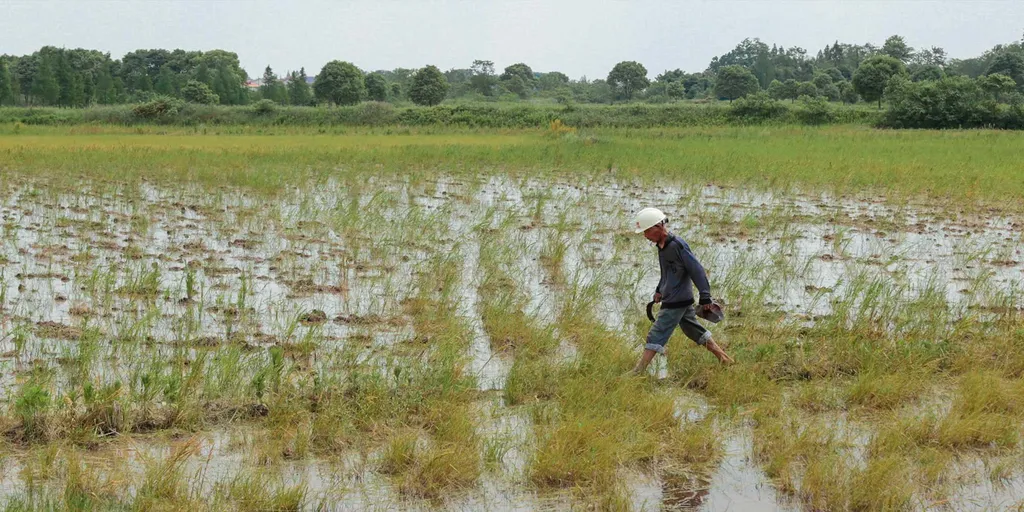
In the heart of China’s coastal regions, where the land meets the sea, a silent battle is being waged against a dual threat to rice production and human health: soil salinity and cadmium (Cd) contamination. A recent study published in *Environmental Chemistry and Ecotoxicology* has shed light on a promising ally in this fight—periphytic biofilm (PB) found at the soil-water interface of paddy fields. The research, led by Lingyuan Chen from the Co-Innovation Center for the Sustainable Forestry in Southern China at Nanjing Forestry University, reveals that PB in saline conditions (SPB) can capture significantly more cadmium than its non-saline counterpart (NPB), offering a potential solution to a pressing agricultural challenge.
Soil salinity not only inhibits rice growth but also enhances the mobility of cadmium, a toxic heavy metal that poses severe risks to both crops and human health. The study found that SPB exhibits a remarkable cadmium capture capability, with a maximum adsorption capacity of 619.7 mg/kg—69% higher than NPB. This enhanced performance is attributed to the higher amount of extracellular polymeric substances (EPS) in SPB, which contain more CHON and CHONS compounds. “The process of cadmium capture by SPB is a spontaneous physical adsorption process driven mainly by EPS,” explains Chen. “Among different EPS layers of SPB, the soluble EPS (S-EPS) accounts for more than 50% of cadmium adsorption.”
The implications for the agriculture sector are substantial. Cadmium contamination in paddy fields is a global issue, with severe consequences for rice production and food safety. The findings suggest that SPB could be harnessed as a natural remediation tool, helping to mitigate cadmium pollution and improve crop yields in saline-affected soils. “This research expands our understanding of cadmium biogeochemistry in saline wetlands with PB,” says Chen. “It highlights the potential of SPB for cadmium pollution remediation in paddy fields, which could have significant commercial impacts for the agriculture sector.”
The study also revealed that SPB possesses higher abundances of metal-tolerant taxa, such as Coleofasciculus chthonoplastes, and enhanced expression of cadmium-related and EPS-related genes. This suggests that SPB not only captures more cadmium but also has a robust microbial community that can thrive in saline conditions, further enhancing its remediation potential.
As the world grapples with the dual challenges of soil salinity and heavy metal contamination, the findings of this study offer a glimmer of hope. By leveraging the natural capabilities of SPB, farmers and agricultural stakeholders could develop innovative strategies to protect their crops and ensure food safety. The research paves the way for future developments in the field, with potential applications ranging from bio-remediation technologies to the development of saline-tolerant crop varieties.
In the words of Lingyuan Chen, “This research is just the beginning. There is still much to learn about the intricate interactions between periphytic biofilm, soil salinity, and heavy metal contamination. But the potential is there, and it is immense.” As we look to the future, the humble periphytic biofilm may well become a cornerstone of sustainable agriculture, helping to feed the world’s growing population while protecting our precious ecosystems.