
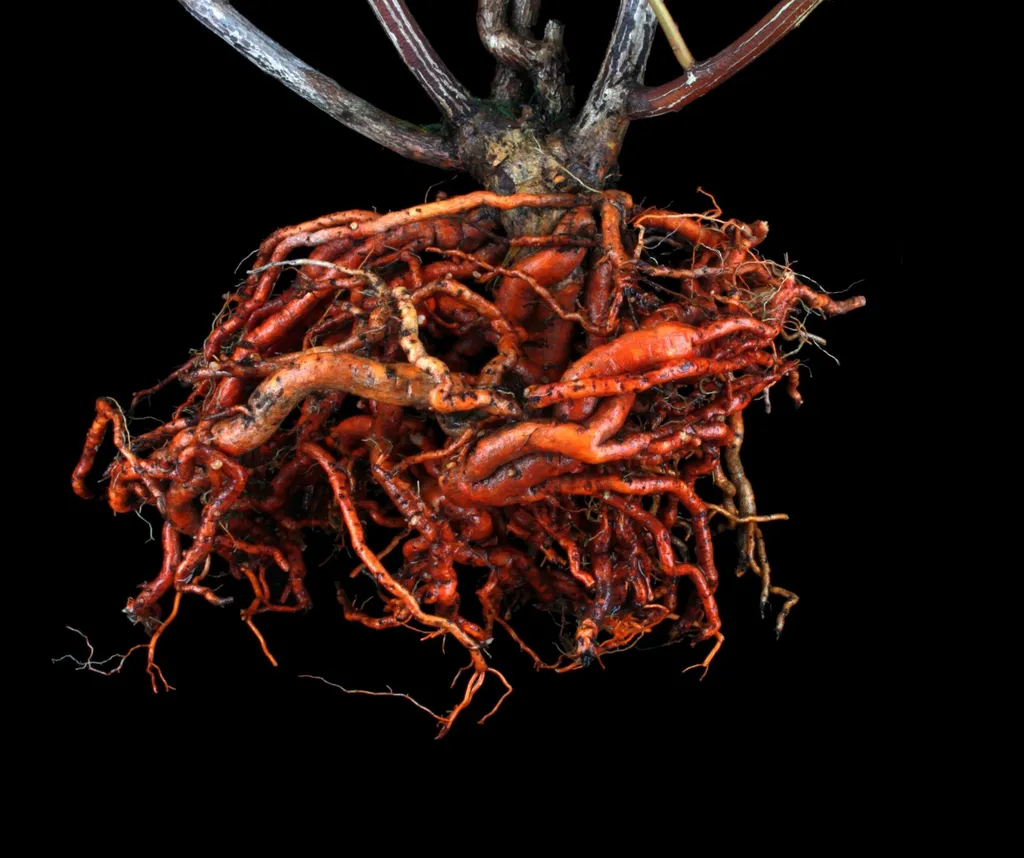
In the heart of China’s agricultural landscape, a silent battle rages beneath the soil, where the roots of wolfberry plants face an insidious foe: Fusarium oxysporum, a pathogen responsible for root rot that threatens the country’s wolfberry production. A recent study published in *Industrial Crops and Products* has shed new light on the defense mechanisms of wolfberry plants, offering hope for more resilient crops and significant commercial impacts for the agriculture sector.
The research, led by Changzheng Liu from the Graduate School of China Academy of Chinese Medical Sciences and the State Key Laboratory for Quality Ensurance and Sustainable Use of Dao-di Herbs, compared the responses of two wolfberry varieties to Fusarium oxysporum infection: the resistant Chinese wolfberry (Lycium chinense Mill.) and the susceptible Ningxia wolfberry ‘Ningqi No.5’.
The findings reveal a fascinating tale of plant defense strategies. “We found that the resistant variety, LC, exhibits stronger oxidative stress tolerance and activates auxin and salicylic acid pathways, while the susceptible variety, N5, primarily induces jasmonic acid and its derivatives,” Liu explains. This distinct regulatory pattern is just the beginning of the story.
The study employed an integrated multi-omics approach, combining transcriptomic, metabolomic, and lipidomic analyses to unravel the complex defense mechanisms at play. LC, with its high basal lignin content, undergoes cell wall modification through lipid metabolism reprogramming after infection, enhancing suberin formation to fend off the pathogen. In contrast, N5, with low basal lignin levels, accelerates the de novo synthesis of lignin and promotes suberization to resist infection.
These findings provide a molecular basis for wolfberry resistance to Fusarium oxysporum and identify potential candidate genes and metabolites that could be exploited in breeding disease-resistant varieties. “This research offers a roadmap for developing more resilient wolfberry crops, which could have significant commercial impacts for the agriculture sector,” says Liu.
The implications of this research extend beyond wolfberry cultivation. Understanding the molecular mechanisms of plant defense against soil-borne pathogens can inform breeding programs and agricultural practices for a wide range of crops. As the global population grows and climate change exacerbates agricultural challenges, the need for resilient and productive crops has never been greater.
This study not only advances our scientific understanding of plant-pathogen interactions but also paves the way for innovative solutions to enhance crop resilience and food security. As the agriculture sector grapples with the threats posed by pathogens and environmental stressors, the insights gained from this research offer a beacon of hope for a more sustainable and productive future.
The research, led by Changzheng Liu from the Graduate School of China Academy of Chinese Medical Sciences and the State Key Laboratory for Quality Ensurance and Sustainable Use of Dao-di Herbs, was published in *Industrial Crops and Products*.