
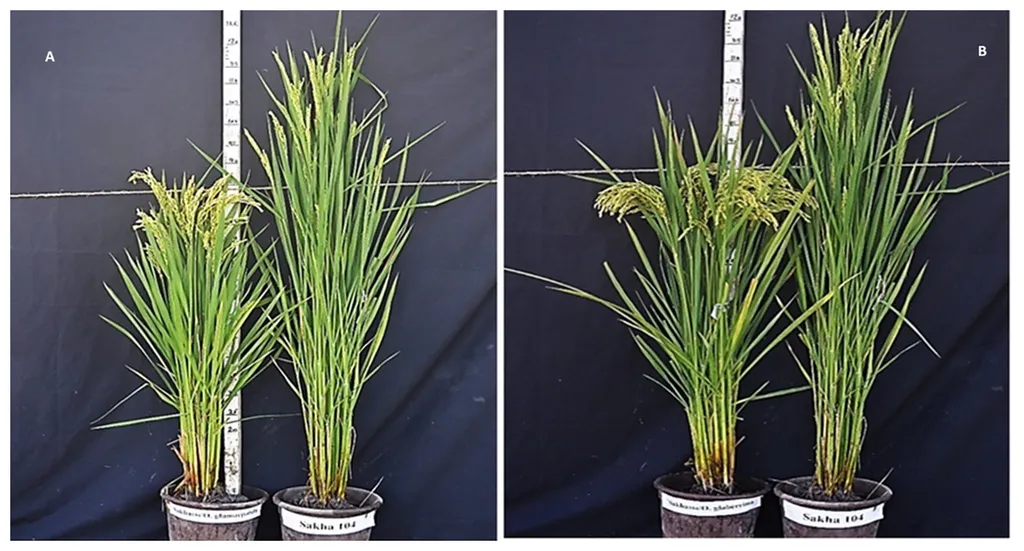
In the face of escalating climate challenges, rice farmers worldwide are grappling with drought stress, which can slash yields by a staggering 50–70%. A recent study published in *BMC Plant Biology* offers a glimmer of hope, revealing how specific rice cultivars in Egypt are adapting to these harsh conditions. The research, led by Sobhi F. Lamlom from the Department of Plant Production at Alexandria University, employed advanced metabolomic techniques to uncover the biochemical secrets behind drought tolerance in rice.
The study focused on four Egyptian rice cultivars—Giza 177, Giza 178, Sakha 104, and Sakha 108—exposed to drought-like conditions induced by polyethylene glycol for 14 days. Among them, Sakha 104 emerged as the top performer, boasting a drought tolerance index of 82.7%. But what sets this cultivar apart? The answer lies in its metabolic makeup.
Using gas chromatography–mass spectrometry (GC-MS), the researchers identified 114 polar metabolites in leaves and 97 in roots, including amino acids, organic acids, sugars, and secondary metabolites. These compounds play a crucial role in osmotic adjustment, helping the plants maintain their cellular functions under stress. “The metabolic adaptability of roots was particularly striking,” noted Lamlom, highlighting that roots exhibited greater variance in their metabolic profiles compared to leaves.
Principal component analysis (PCA) revealed that roots accounted for 70.4% of the metabolic variance, while leaves contributed 53.9%. This suggests that roots are the primary sensors and responders to drought stress, a finding that could revolutionize breeding programs. “Understanding these tissue-specific adaptation strategies is key to developing more resilient rice varieties,” Lamlom explained.
The study also identified 40 metabolites with significant discriminatory capacity, including 13 priority biomarkers. These biomarkers, such as leucine, L-serine, adenosine-5’-monophosphate, oxalic acid, spermine, and shikimic acid, could serve as valuable indicators for breeding programs aiming to enhance drought tolerance.
One of the most intriguing findings was the tissue-specific clustering of metabolomes. While leaf metabolomes grouped by treatment, root metabolomes clustered by cultivar, indicating that roots employ unique biochemical strategies to cope with drought. This discovery underscores the importance of root-specific metabolic profiling in breeding programs.
The commercial implications of this research are profound. By identifying metabolic biomarkers associated with drought tolerance, breeders can develop rice varieties that are not only more resilient but also more productive under water-scarce conditions. This could significantly boost rice yields in drought-prone regions, enhancing food security and economic stability for farmers.
The study also sheds light on the broader agricultural landscape, suggesting that metabolomic profiling could be a game-changer in crop improvement. “This research provides a roadmap for leveraging metabolomics to enhance drought tolerance in other crops,” Lamlom said, hinting at the potential for broader applications in agriculture.
As climate change continues to threaten global food security, the insights from this study offer a beacon of hope. By harnessing the power of metabolomics, the agricultural sector can develop more resilient crops, ensuring a stable food supply for future generations. The research, published in *BMC Plant Biology* and led by Sobhi F. Lamlom from Alexandria University, marks a significant step forward in the quest for drought-tolerant rice varieties.