
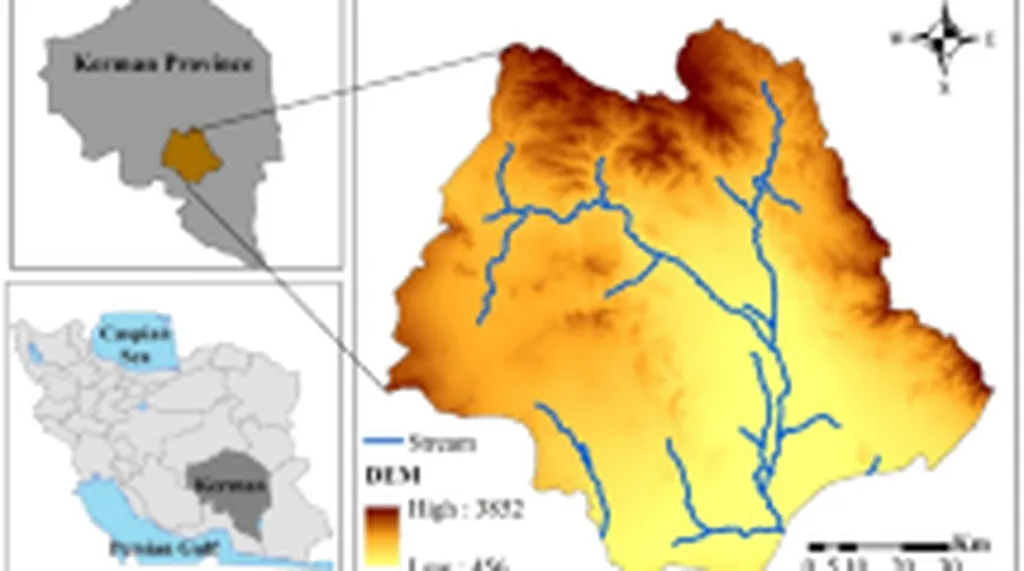
In the heart of Iran’s semi-arid Arak County, a groundbreaking study is reshaping how we think about crop planning and water management. Majid Naeimi, a researcher from the Department of Water Science and Engineering at Arak University, has developed a novel approach to optimize cropping patterns, addressing the critical issue of water scarcity in arid and semi-arid regions. Published in *Scientific Reports*, Naeimi’s work combines Geographic Information Systems (GIS) with Multi-Criteria Decision Making (MCDM) to create a framework that could revolutionize agricultural productivity and sustainability.
The study focuses on seven key crops: wheat, barley, alfalfa, forage corn, beans, potatoes, and orchards. By integrating various factors such as water resources, soil quality, technical infrastructure, social dynamics, economic considerations, and agricultural needs, Naeimi’s model provides a comprehensive analysis of the best cropping patterns for the region. “The goal is to improve both physical and economic water productivity,” Naeimi explains. “This is crucial for ensuring food security and sustainable agricultural practices in water-scarce areas.”
The research employs a sophisticated methodology, including the Delphi method, CVR index, DEMATEL model, and a hybrid AHP-TOPSIS model. These tools help determine the weight of different sub-criteria and their interrelationships, ultimately creating a map of suitable areas for each crop. The study identifies the most significant factors influencing agricultural productivity, such as the use of modern irrigation systems, soil texture, land ownership status, and crop water requirements.
One of the most compelling findings is the identification of optimal cropping patterns. The fourth and fifth patterns, prioritizing orchards and forage corn respectively, emerged as the most superior. “The fourth pattern, with a focus on orchards, offers an economic productivity of 65,835 IRR per cubic meter of water,” Naeimi notes. “This highlights the potential for significant economic gains while conserving water resources.”
The commercial implications of this research are substantial. By optimizing cropping patterns, farmers can enhance their yields and profitability, even in water-scarce environments. This approach not only benefits individual farmers but also contributes to the broader goal of food security. “The framework we’ve developed can be adapted to other regions facing similar challenges,” Naeimi adds. “It provides a scalable solution that can be tailored to local conditions, making it a valuable tool for policymakers and agricultural planners.”
As the world grapples with the impacts of climate change and water scarcity, Naeimi’s research offers a beacon of hope. By integrating advanced technologies and data-driven decision-making, the agricultural sector can achieve greater sustainability and resilience. This study not only advances our understanding of optimal cropping patterns but also paves the way for innovative solutions that can transform the future of agriculture.