
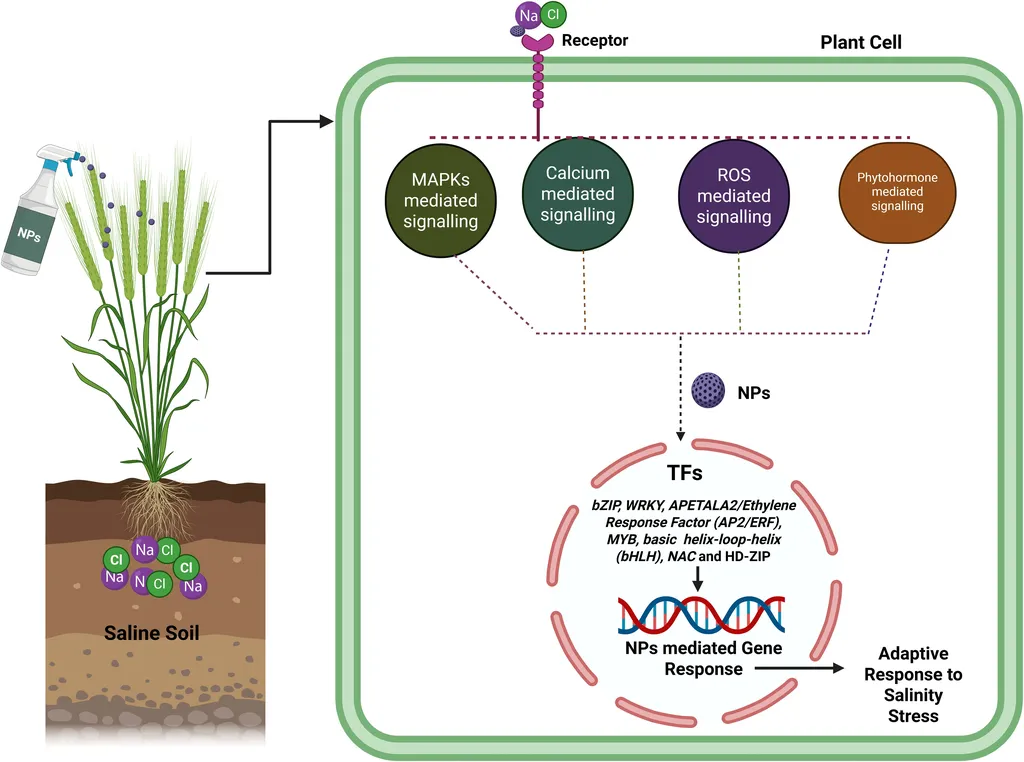
In the face of escalating soil salinization, which threatens over 6% of the world’s arable land, researchers have uncovered a promising strategy to boost crop resilience. A recent study published in *Agricultural Water Management* reveals that combining multi-walled carbon nanotubes (MWCNTs) with the beneficial bacterium *Bacillus subtilis* under drip irrigation can significantly enhance maize tolerance to salt stress. This innovative approach could revolutionize agriculture in saline ecosystems, offering a sustainable alternative to traditional, often costly remediation methods.
The study, led by Yi Liu from Hohai University and Wuhan University, demonstrates that MWCNTs alone can markedly improve seed germination and root elongation in saline soils. “We observed a 52% germination rate by day two with MWCNTs, compared to just 24% in controls,” Liu explains. This enhancement is attributed to the upregulation of key ion transporters and aquaporin genes, which facilitate better water and nutrient uptake under salt stress.
However, the real breakthrough comes from the synergy between MWCNTs and *B. subtilis*. When combined, these agents foster stronger soil-microbe-nanomaterial interactions, leading to a 20.6% increase in maize yield and a 3.08% rise in 1000-grain weight. The combination also lowers the leaf Na⁺/K⁺ ratio by 19.93% and boosts antioxidant defense mechanisms, such as a 10.44% increase in SOD activity. “The uniform distribution provided by drip irrigation reinforces these effects, making the approach both effective and sustainable,” Liu adds.
One of the study’s most intriguing findings is that while MWCNTs alone can decrease soil nitrogen in non-saline conditions, the addition of *B. subtilis* helps rebalance nutrients. This balance is crucial for maintaining soil health and fertility, particularly in saline agricultural ecosystems.
The implications for the agriculture sector are substantial. With soil salinization projected to worsen due to climate change and intensive farming practices, this nano-bio strategy offers a promising solution for reclaiming degraded lands. By integrating nanotechnology, microbiome engineering, and water-efficient irrigation, farmers can enhance crop resilience and productivity, ultimately securing food supplies and economic stability in saline regions.
This research not only advances our understanding of molecular soil-root interactions but also paves the way for future developments in stress-resistant agriculture. As the global population grows and arable land becomes scarcer, such innovations will be crucial in meeting the world’s food demands sustainably. The study, led by Yi Liu from the College of Agricultural Science and Engineering at Hohai University and the State Key Laboratory of Water Resources Engineering and Management at Wuhan University, marks a significant step forward in the quest for sustainable agriculture solutions.