
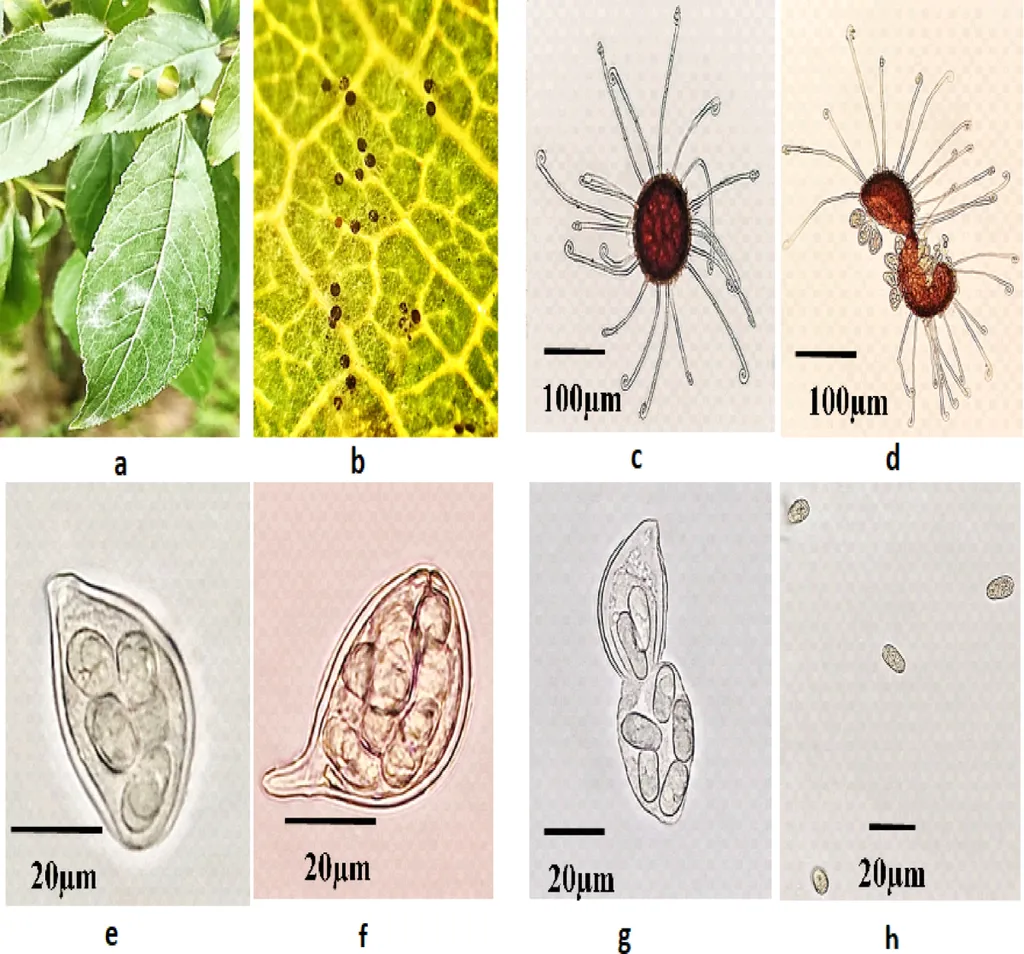
In the verdant landscapes of Ardabil province, Iran, a silent battle rages between farmers and an unseen foe: powdery mildew fungi. These microscopic invaders, belonging to the family Erysiphaceae, can wreak havoc on crops, reducing yields and diminishing product quality. Yet, a recent study published in ‘پژوهشهای حفاظت گیاهان ایران’ sheds new light on these pathogens, offering hope for better management and control.
Powdery mildews are obligate biotrophs, meaning they rely on living plant cells for sustenance. They manifest as white, yellow, brown, or gray spots or layers on leaves, caused by the fungi’s mycelium or spherical sexual structures. The study, led by Afsaneh Saheli from the Department of Plant Protection at Mohaghegh Ardabili University, identified seven genera and 33 species of these fungi in Ardabil province, a region known for its diverse climate and agriculture.
Saheli’s team collected samples from various crops, landscapes, fruit trees, and forests over two years. They identified the fungi using microscopic analyses and specialized literature. Their findings revealed that four species are reported for the first time in Iran, and 11 species are new to Ardabil province. Notably, they found Erysiphe trifoliorum on clover, Golovinomyces orontii on ash and lettuce, and Leveillula taurica on common vetch, all new host records for Iran.
The commercial impact of these findings is significant. Powdery mildew can cause substantial economic losses in agriculture due to reduced yield and quality. “Accurate identification of these fungi, their host range, and geographical distribution can be useful in biodiversity studies as well as management of these pathogens,” Saheli explained.
Understanding the distribution and host range of these fungi is crucial for developing effective control strategies. Farmers can use this information to monitor and manage powdery mildew more effectively, reducing crop losses and improving yields. Moreover, the study highlights the importance of continuous research and surveillance in the field of plant pathology.
The research also underscores the need for integrated pest management (IPM) strategies. IPM combines biological, cultural, physical, and chemical methods to control pests and diseases, minimizing economic, health, and environmental risks. By identifying the specific fungi affecting crops in Ardabil province, farmers can tailor their IPM strategies to target these pathogens more effectively.
Looking ahead, this research could shape future developments in the field by providing a foundation for further studies on powdery mildew fungi. Future research could explore the genetic diversity of these fungi, their interaction with host plants, and the development of resistant crop varieties. Additionally, the study could inform policy decisions related to plant health and biodiversity conservation.
In conclusion, Saheli’s study is a significant step forward in understanding and managing powdery mildew fungi in Ardabil province. By providing detailed information on the distribution and host range of these pathogens, the research offers valuable insights for farmers, researchers, and policymakers alike. As the battle against powdery mildew continues, this study serves as a beacon of hope for a more sustainable and productive future in agriculture.