
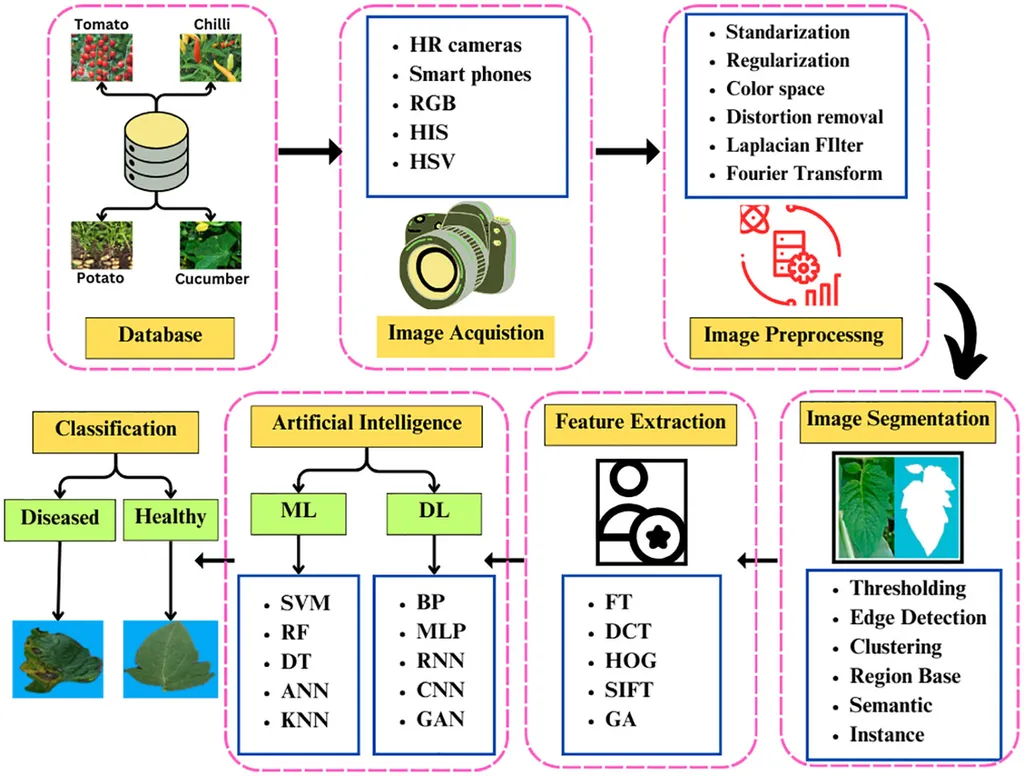
In the heart of Pakistan’s agricultural landscape, where the effects of climate change are increasingly felt, a new technological breakthrough is offering hope to farmers battling crop diseases. Researchers have developed a lightweight, deep learning-based solution that can diagnose and classify apple crop diseases right on the farmer’s device, without the need for internet connectivity. This innovation, published in the Journal of the Saudi Society of Agricultural Sciences, is a significant step towards empowering farmers in resource-constrained environments.
The study, led by Sadaf Iftikhar from the National University of Sciences and Technology (NUST), addresses a critical gap in agricultural technology. Many existing solutions rely on heavy mobile applications and cloud-based services, which can be prohibitively expensive and inaccessible in rural areas. “The challenge has been to create a solution that is both efficient and accessible,” Iftikhar explains. “We needed a model that could run on low-power devices and provide accurate results without the need for constant internet access.”
The researchers experimented with various deep neural network (DNN) models, including Basic CNN Architecture, AlexNet, and EfficientNet Lite. After a thorough evaluation, they found that a transfer learning strategy on a specially developed EfficientNet DNN architecture achieved the best performance, with an impressive 85% test accuracy. This model can run on edge devices like mobile phones, Raspberry Pi, and Jetson Nano-based devices, making it highly accessible for farmers in remote areas.
The commercial impacts of this research are substantial. By enabling early and accurate disease diagnosis, farmers can take timely action to protect their crops, reducing losses and improving yields. This is particularly important in regions like Pakistan, where financial constraints and lack of technology have historically hindered agricultural productivity. “This technology has the potential to revolutionize precision agriculture,” says Iftikhar. “It can help farmers make data-driven decisions, optimize resource use, and ultimately increase their income.”
The implications of this research extend beyond apple crops and Pakistan’s borders. The lightweight, on-device classification model can be adapted for other crops and regions, offering a scalable solution for global agricultural challenges. As the world grapples with climate change and food security issues, such innovations are crucial for building resilient and sustainable agricultural systems.
This breakthrough also highlights the growing importance of edge computing in agriculture. By processing data locally on edge devices, farmers can reduce latency, power consumption, and computational costs. This trend is expected to shape the future of agricultural technology, with more efficient and accessible solutions being developed for farmers worldwide.
In the face of climate change and food security challenges, this research offers a beacon of hope. By leveraging the power of deep learning and edge computing, it provides a practical, accessible solution for farmers in resource-constrained environments. As the agricultural sector continues to evolve, such innovations will be key to building a more sustainable and productive future.