
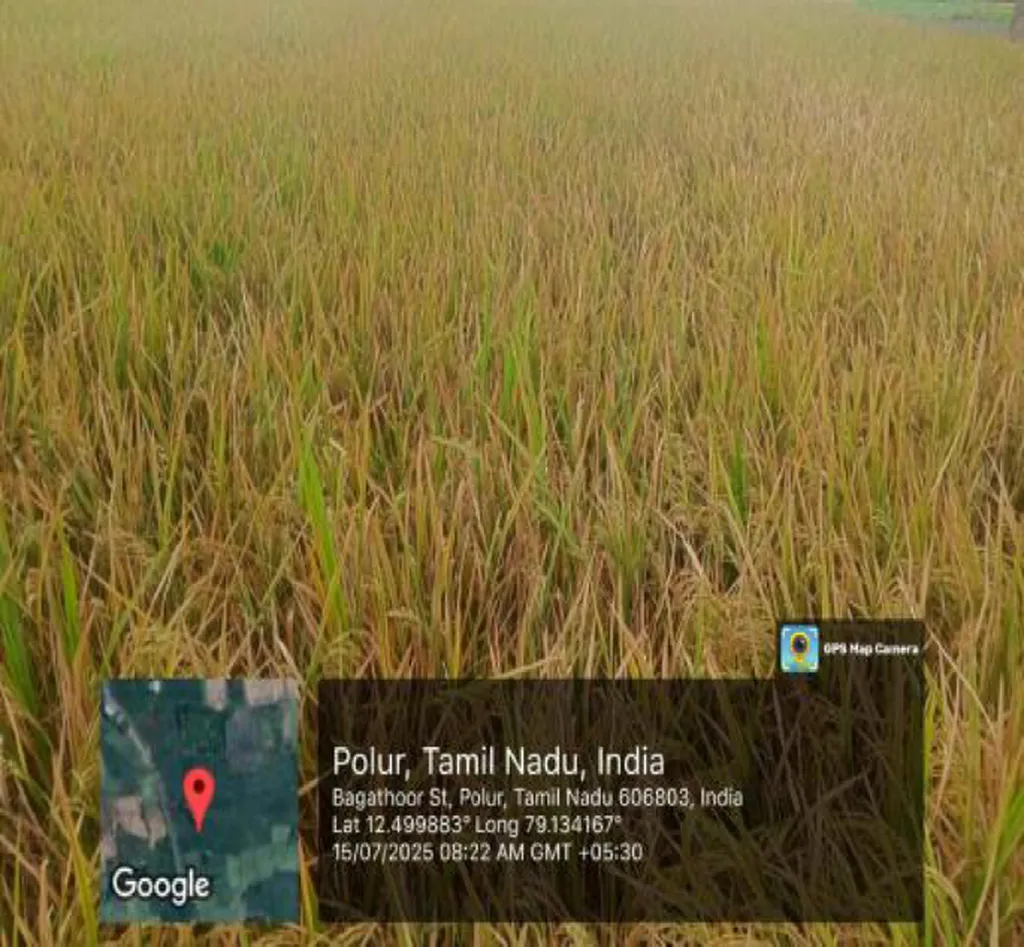
In the ever-evolving landscape of precision agriculture, a groundbreaking study has emerged that could redefine how farmers monitor and manage crop health. Researchers have developed a novel framework that dynamically formulates vegetation indices tailored for rice stress detection, integrating satellite and mobile imagery to provide early warnings and potentially save yields.
Traditional vegetation indices, such as NDVI (Normalized Difference Vegetation Index) and EVI (Enhanced Vegetation Index), have been staples in agricultural monitoring for decades. However, these static, crop-agnostic metrics often fail to detect early stress signals, leaving farmers with limited time to intervene. Enter RL-VI, a reinforcement learning-based framework that adapts to the unique needs of rice crops, offering a dynamic and responsive approach to stress detection.
The study, led by Poornima Seralathan from the Department of Electronics and Communication Engineering at SRM Institute of Science and Technology, was recently published in *Scientific Reports*. RL-VI stands out by combining Sentinel-2 multispectral imagery with smartphone-captured RGB data, creating a cross-platform environment where vegetation indices are learned rather than predefined. This adaptability allows the system to select stress-sensitive spectral band combinations, guided by classification rewards, and tailored to the specific needs of rice crops.
“RL-VI is not just another vegetation index; it’s a paradigm shift in how we approach crop stress detection,” Seralathan explained. “By leveraging reinforcement learning, we’ve created a system that continuously learns and adapts, providing farmers with actionable insights that were previously unattainable.”
The implications for the agriculture sector are profound. Early stress detection, up to 10-14 days before visible symptoms appear, offers farmers a critical window to intervene and mitigate potential yield losses. This proactive approach aligns with the growing demand for sustainable agriculture practices, where resource efficiency and environmental stewardship are paramount.
The study’s experiments on real-world rice fields in Tamil Nadu, India, and benchmark datasets demonstrated RL-VI’s superior performance, achieving an overall accuracy of 89.4% and an F1-score of 0.88. These results outperform static and machine-learned indices by up to 12%, highlighting the potential of this technology to revolutionize crop monitoring.
Beyond its accuracy, RL-VI is designed to be computationally lightweight and scalable, making it accessible for use with UAVs (unmanned aerial vehicles) or edge devices. This scalability ensures that the technology can be deployed at the field level, bridging the gap between mobile sensing and satellite monitoring. The result is a low-cost, real-time crop health management tool that empowers farmers with the data they need to make informed decisions.
The commercial impact of this research could be substantial. By enabling early detection of crop stress, RL-VI can help farmers reduce input costs, optimize resource use, and ultimately increase yields. This technology aligns with the broader trend toward precision agriculture, where data-driven insights are used to enhance productivity and sustainability.
As the agriculture sector continues to embrace technological advancements, the integration of reinforcement learning and remote sensing offers a glimpse into the future of crop monitoring. The success of RL-VI paves the way for further innovations in this field, potentially extending its application to other crops and agricultural practices.
In a world where climate change and resource scarcity pose significant challenges to global food security, technologies like RL-VI represent a beacon of hope. By providing farmers with the tools they need to detect and address crop stress early, we can move closer to a future where sustainable and productive agriculture is the norm.
The study’s statistical validation, including ANOVA (F = 88.24, p < 0.001) and pairwise t-tests (p < 0.001), underscores the robustness of RL-VI's performance. SHAP analyses further emphasized the physiological significance of red-edge and SWIR bands in stress discrimination, adding another layer of scientific rigor to the findings.As the agriculture sector looks to the future, the integration of reinforcement learning and remote sensing offers a promising path forward. The success of RL-VI not only highlights the potential of this technology but also sets the stage for further innovations in precision agriculture. With continued research and development, we can expect to see even more advanced tools that empower farmers to meet the challenges of a changing world.