
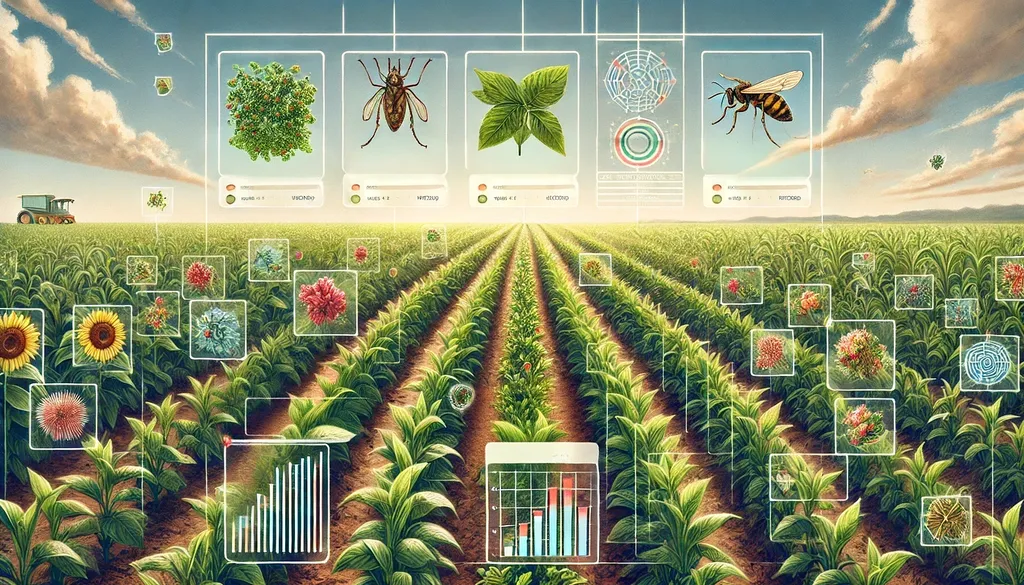
In the relentless battle against crop diseases, farmers and agronomists are gaining a powerful new ally: the combination of Unmanned Aerial Vehicles (UAVs) and Artificial Intelligence (AI). A recent review published in *Phytopathogenomics and Disease Control* sheds light on how these technologies are revolutionizing crop disease monitoring, offering a glimpse into a future where disease management is proactive, precise, and scalable.
Plant diseases are a significant threat to global food security, causing a staggering $220 billion in lost productivity annually. Traditional methods of disease detection, such as manual scouting and laboratory diagnostics, often fall short in the face of large-scale agriculture and the need for early, pre-symptomatic detection. This is where UAVs and AI step in, providing a faster, more efficient, and data-driven approach to crop health monitoring.
The review, led by Umer Farooq, explores the various types of sensors used in UAVs, including RGB, multispectral, hyperspectral, thermal, and LiDAR. Each of these sensors captures different aspects of crop health, from visible signs of disease to subtle changes in plant physiology. The data collected by these sensors is then processed using AI algorithms, with machine learning (ML) and deep learning (DL) techniques playing a pivotal role.
One of the most promising AI techniques discussed in the review is the use of Convolutional Neural Networks (CNNs). These advanced algorithms have demonstrated an impressive accuracy rate of 90–98% in identifying diseases in crops such as wheat, potatoes, citrus, and grapevines. “The integration of UAVs and AI is a game-changer for the agriculture sector,” says Farooq. “It allows for early detection and targeted treatment, significantly reducing crop losses and improving food security.”
The review also highlights the potential of data fusion, edge computing, and autonomous scouting. Data fusion involves combining data from multiple sensors to gain a more comprehensive understanding of crop health. Edge computing, on the other hand, enables real-time data processing and decision-making, reducing the need for centralized data centers. Autonomous scouting takes this a step further, with UAVs capable of independently monitoring and assessing crop health.
The commercial impacts of these advancements are substantial. By enabling early detection and precise treatment, UAVs and AI can help farmers reduce crop losses, improve yields, and increase profitability. Moreover, these technologies can contribute to sustainable agriculture by minimizing the use of pesticides and other chemicals.
Looking ahead, the integration of UAVs and AI in crop disease monitoring is poised to shape the future of agriculture. As Farooq notes, “The future lies in proactive, scalable, and precise disease management. With the continued advancement of UAV and AI technologies, we can expect to see a significant shift in how we approach crop health and food security.”
In the ever-evolving landscape of agriculture, the marriage of UAVs and AI is a beacon of hope, offering a path towards a more sustainable and food-secure future. As we stand on the brink of this technological revolution, one thing is clear: the future of agriculture is not just about growing crops; it’s about growing smarter.