
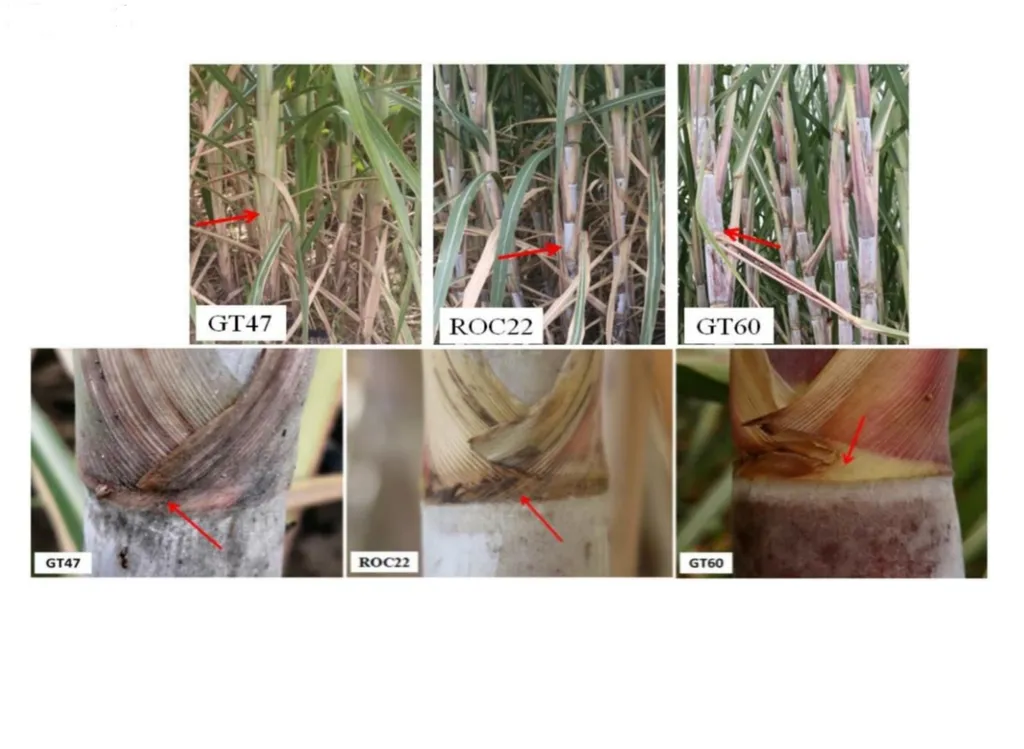
In a groundbreaking study published in *Industrial Crops and Products*, researchers have unraveled the intricate mechanisms behind sugarcane defoliation, a critical trait for efficient harvesting. Led by Zhengying Luo from the College of Agronomy and Biotechnology at Yunnan Agricultural University, the research offers a molecular framework that could revolutionize sugarcane agriculture and potentially extend to other perennial grasses.
Sugarcane defoliation at maturity is a complex process involving distinct morphological changes, such as increased leaf angle and progressive sheath cracking. These changes are closely linked to the development of aerenchyma—spongy tissues that facilitate gas exchange—and the accumulation of hydrogen peroxide (H₂O₂). The study employed a multi-omics approach, integrating transcriptomic and small RNA profiling, to dissect the regulatory processes underlying these changes.
The research identified key biological processes, including cell wall reorganization and redox homeostasis, as central to the defoliation process. Notably, the study pinpointed AP2–1 and SPL12 as central hubs in regulating cell wall and cytoskeletal dynamics. “The miR172y-AP2–1 module plays a pivotal role in this regulation,” explained Luo. “miR172y directly represses the nuclear-localized AP2–1, which in turn influences a cascade of signaling pathways.”
Functional validation of these findings revealed that overexpressing AP2–1 in transgenic rice enhanced aerenchyma formation and increased susceptibility to sheath detachment. These transgenic lines exhibited elevated levels of 1-aminocyclopropane-1-carboxylic acid (ACC), cell wall components, and H₂O₂. The study further demonstrated that AP2–1 overexpression led to coordinated alterations in ethylene biosynthesis and signaling, as well as reactive oxygen species (ROS) homeostasis. These changes collectively promote aerenchyma development, offering a novel understanding of leaf detachment in perennial grasses.
The commercial implications of this research are substantial. By identifying the miR172-AP2–1 module as a key regulator of defoliation, the study provides actionable genetic targets for improving harvest efficiency in sugarcane. This could lead to the development of sugarcane varieties that defoliate more predictably and efficiently, reducing labor costs and improving overall yield. “This research not only advances our understanding of sugarcane defoliation but also opens up new avenues for genetic engineering in other crops,” Luo added.
The findings published in *Industrial Crops and Products* by lead author Zhengying Luo from the College of Agronomy and Biotechnology at Yunnan Agricultural University, offer a promising pathway for enhancing agricultural productivity and sustainability. As the global demand for sugarcane continues to rise, this research could pave the way for more efficient and cost-effective harvesting practices, benefiting farmers and the agricultural industry alike.