
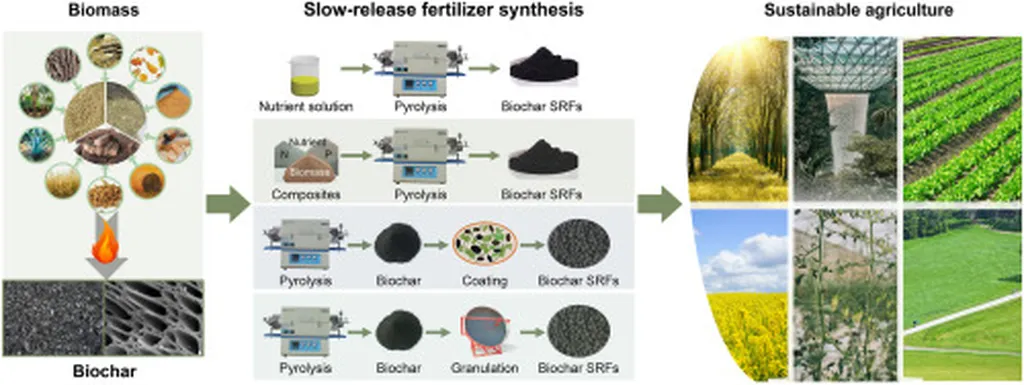
In the quest to feed a growing global population while minimizing environmental impact, researchers are turning to an ancient material with a modern twist: biochar. A recent review published in *Sustainability Science and Technology* sheds light on the promising potential of biochar-based fertilizers (BBFs) to revolutionize sustainable agriculture. Led by Tochukwu Ozor from the Department of Agricultural and Biosystems Engineering at South Dakota State University, the study highlights how integrating biochar with nutrient-rich materials could significantly boost crop yields and soil health, offering a sustainable alternative to conventional fertilizers.
Biochar, a carbon-rich substance produced through the pyrolysis of organic materials, has long been recognized for its ability to improve soil structure, water retention, and microbial activity. However, its lack of inherent nutrients has limited its use as a standalone fertilizer. The review underscores the transformative potential of BBFs, which combine biochar with organic and inorganic nutrients. According to the research, BBFs can increase crop yields by up to 94%, reduce nitrate leaching by 68%, and enhance soil phosphorus availability by 45%. These findings suggest that BBFs could play a pivotal role in addressing the dual challenges of food security and environmental sustainability.
“Integrating biochar with nutrient-rich materials offers a promising path toward sustainable crop production,” Ozor explains. “However, the performance of BBFs depends strongly on the type of biochar used, the enrichment materials, production methods, and soil conditions.” This variability underscores the need for standardized evaluation frameworks and regional validation to ensure consistent results across different agricultural contexts.
Despite the promising benefits, several challenges hinder the widespread adoption of BBFs. High production costs, scalability constraints, and a lack of standardization remain significant barriers. The review also identifies critical gaps in current research, including inconsistent yield responses in fertile soils and the uncertain long-term behavior of heavy metals in manure-derived biochar. Addressing these challenges will require a multifaceted approach, including direct performance comparisons of different biochars, standardized evaluation frameworks, and life-cycle economic assessments.
The commercial implications of this research are substantial. As the agriculture sector seeks to adopt more sustainable practices, BBFs could emerge as a key player in the market for nutrient-efficient, climate-resilient fertilizers. By optimizing the selection and production of biochar, farmers and agribusinesses could achieve higher yields while reducing environmental impact, ultimately contributing to a more sustainable and economically viable agricultural future.
The review calls for future studies to focus on direct performance comparisons of different biochars, the development of standardized evaluation frameworks, and regional field validation. “We need a comprehensive understanding of how different biochars perform in various agricultural contexts to accelerate their adoption,” Ozor emphasizes. This research not only highlights the potential of BBFs but also sets the stage for future innovations in sustainable agriculture.
As the global population continues to grow, the need for innovative, sustainable solutions in agriculture becomes increasingly urgent. The insights provided by this review offer a roadmap for leveraging biochar-based fertilizers to meet these challenges head-on, paving the way for a more resilient and productive agricultural sector.