
In a groundbreaking study published in *Communications Earth & Environment*, researchers have uncovered a critical link between crop diversification and nitrogen losses in agricultural soils. The findings suggest that diversified crop rotations can significantly improve yield-scaled denitrification, offering a promising pathway to sustainable food production while minimizing environmental impact.
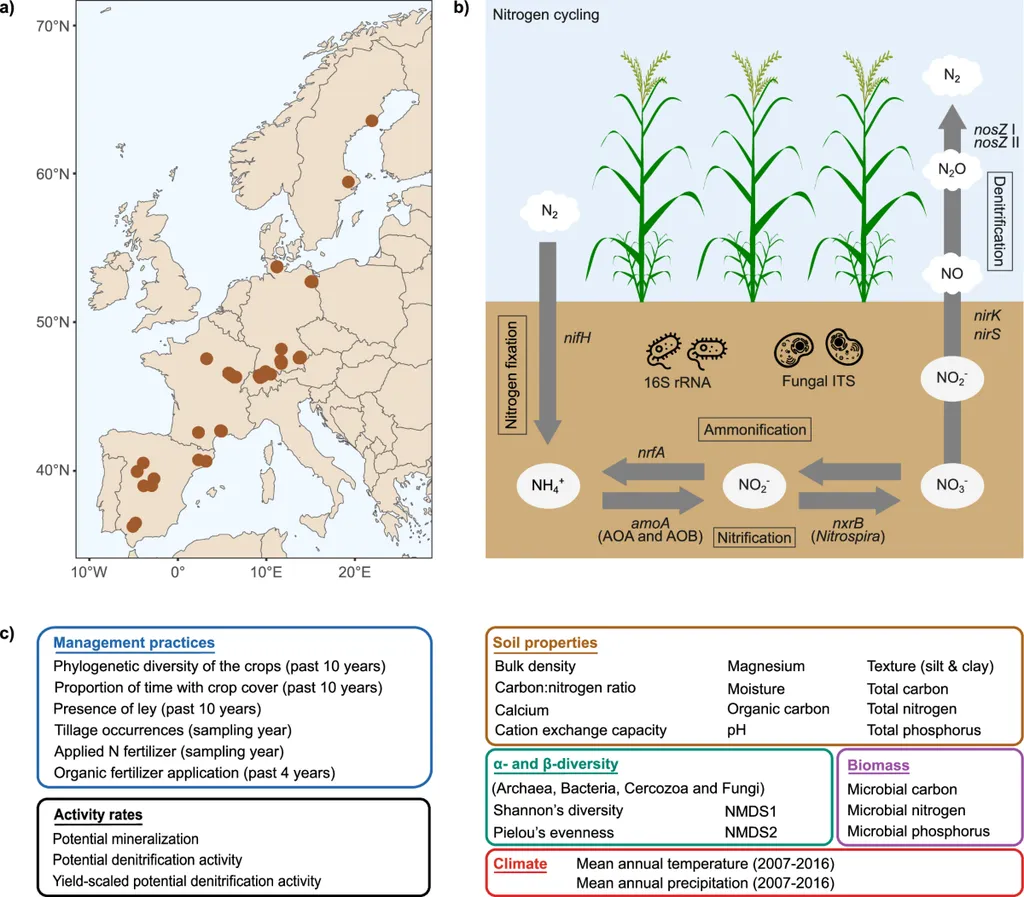
Denitrification, the process by which nitrogen is converted into gaseous forms and released into the atmosphere, is a major source of nitrogen emissions from agricultural soils. These emissions not only contribute to climate change but also deplete soil fertility, posing a significant challenge for farmers. The study, led by Aurélien Saghaï from the Department of Forest Mycology and Plant Pathology at the Swedish University of Agricultural Sciences, sampled 106 cereal fields across a 3000 km North-South gradient in Europe. The researchers compiled data on 56 climatic, soil, microbial, and management variables to understand how different farming practices influence denitrification.
The results revealed that increased denitrification potential was closely associated with a higher proportion of time with crop cover over the past decade. “We found that microbial biomass and specific microbial functional guilds involved in nitrogen cycling, particularly denitrification, were the best predictors of denitrification potential,” Saghaï explained. This highlights the crucial role of belowground diversity in managing nitrogen losses.
The study also demonstrated that several diversification practices affect the variation in denitrification potential predictors, suggesting a trade-off between agricultural diversification and nitrogen losses. However, the most significant finding was that increased crop diversity in rotations improved yield-scaled denitrification. This means that farmers can potentially minimize nitrogen losses while maintaining or even enhancing crop yields.
The commercial implications for the agriculture sector are substantial. As the global push for sustainable agriculture intensifies, farmers are increasingly seeking practices that balance productivity with environmental stewardship. Diversified crop rotations offer a practical solution, reducing the need for synthetic fertilizers and mitigating nitrogen emissions. “This research provides a strong case for adopting diversified crop rotations as a key strategy in sustainable agriculture,” Saghaï noted.
The findings could shape future developments in agritech, encouraging the development of precision farming tools that optimize crop rotations for both yield and environmental benefits. Additionally, the study underscores the importance of microbial health in soil management, paving the way for innovative biofertilizers and soil amendments that enhance microbial diversity and function.
As the agriculture sector continues to evolve, the integration of diversified crop rotations into mainstream farming practices could revolutionize how we produce food, ensuring food security while protecting the planet. This research not only advances our understanding of nitrogen cycling but also offers a tangible path forward for sustainable agriculture.