
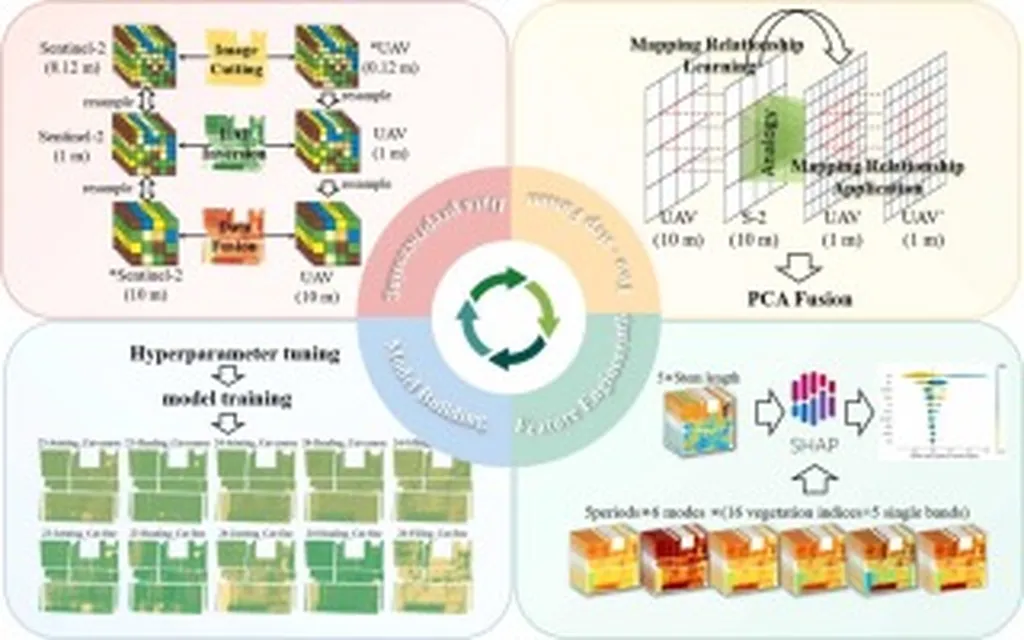
In the ever-evolving landscape of precision agriculture, researchers are continually seeking innovative methods to monitor crop health with greater accuracy. A recent study published in the *IEEE Journal of Selected Topics in Applied Earth Observations and Remote Sensing* offers a promising advancement in this realm. Led by Yaxiao Niu from the School of Agricultural Engineering at Jiangsu University, the research explores how combining spectral, textural, and physiological features can significantly enhance the estimation of winter wheat chlorophyll fluorescence parameter Fv/Fm.
Chlorophyll fluorescence, particularly the ratio of variable fluorescence to maximum fluorescence (Fv/Fm), is a critical indicator of photosynthetic health in crops. Accurate estimation of this parameter via remote sensing has long been a challenge, but the integration of multiple data sources could be a game-changer. “By fusing spectral, textural, and physiological features, we can achieve a more comprehensive and accurate assessment of crop health,” Niu explains. This approach not only improves the precision of Fv/Fm estimation but also provides farmers with actionable insights for better crop management.
The study conducted field experiments across the 2022–2023 winter wheat growing season, evaluating five feature fusion strategies. These strategies combined vegetation indices (VIs) derived from autonomous aerial vehicle (AAV) multispectral images, texture features (TFs) extracted from AAV RGB images, and leaf chlorophyll content (SPAD). The results were compelling: integrating all three feature types achieved optimal performance, increasing validation R² from 0.70 to 0.85 and reducing root-mean-square error from 0.08 to 0.05 compared with single-feature models.
The commercial implications of this research are substantial. Precision agriculture relies on accurate and timely data to optimize resource use and maximize yields. By leveraging multifeature fusion, farmers can gain a more nuanced understanding of their crops’ health, enabling them to make informed decisions about irrigation, fertilization, and pest control. “This technology has the potential to revolutionize how we monitor and manage crops, ultimately leading to more sustainable and productive agricultural practices,” Niu adds.
The study also highlights the importance of feature selection. While individual features like ExGR, SIPI, MCARI, and NDVI705 showed strong correlations with Fv/Fm, the integration of multiple features proved to be more effective. This underscores the need for a holistic approach in agricultural remote sensing, where the synergy of different data types can unlock new levels of accuracy and insight.
As the agriculture sector continues to embrace technology, the findings from this research could pave the way for more advanced and scalable tools. The use of AAVs for data collection, combined with sophisticated machine learning algorithms, offers a glimpse into the future of precision agriculture. “This is just the beginning,” Niu notes. “As we continue to refine these methods, we can expect even greater advancements in crop monitoring and management.”
In conclusion, the study by Yaxiao Niu and colleagues represents a significant step forward in the field of agricultural remote sensing. By demonstrating the viability of multifeature fusion for accurate Fv/Fm monitoring, it provides a robust framework for enhancing crop health assessment. As the agriculture sector strives for greater efficiency and sustainability, such innovations will be crucial in shaping the future of farming.