
In the ever-evolving landscape of food safety, researchers are continually seeking innovative methods to detect and capture harmful pathogens. A recent study published in *AMB Express* has shed new light on optimizing immunomagnetic separation (IMS) techniques, offering promising advancements for the agriculture sector. The research, led by Assem Abolmaaty from the Department of Food Science at Ain Shams University, focuses on enhancing the efficiency of capturing E. coli O157:H7 from ground beef samples, a critical concern for food safety and public health.
Immunomagnetic separation is a powerful tool that uses antibody-coated magnetic beads to target and capture specific cells, such as E. coli O157:H7. The study delves into the intricacies of the antigen-antibody (Ag-Ab) reaction, exploring how various factors influence the binding efficiency of target cells to these magnetic beads. By meticulously examining variables like IgG concentration, incubation temperature, and incubation time, the researchers aimed to maximize the capture of E. coli O157 cells.
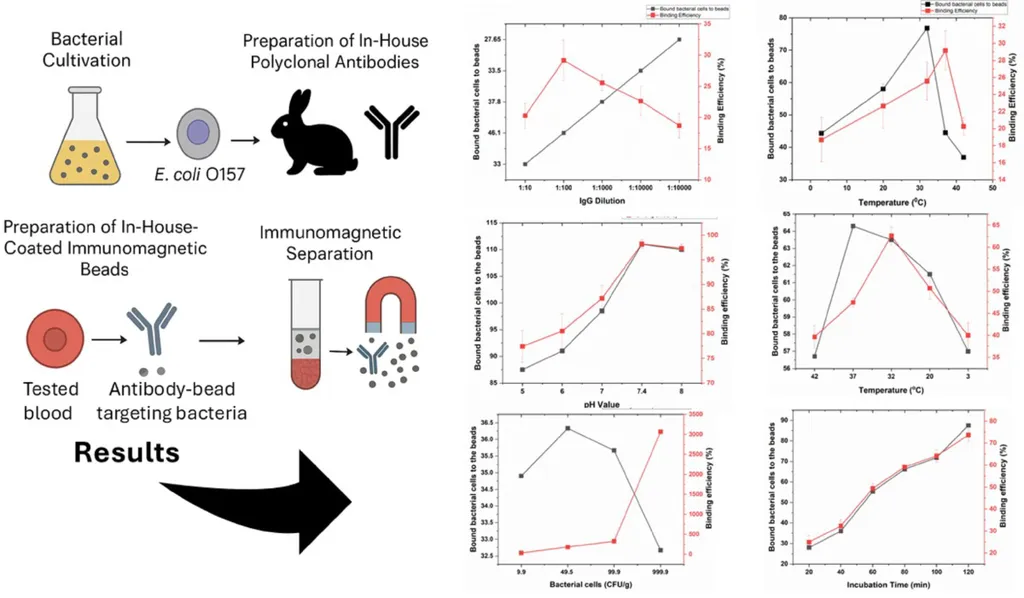
One of the key findings of the study is the concentration-dependent relationship between IgG dilution and binding efficiency. “We observed that lower dilutions of IgG, specifically at a 1:100 ratio, yielded higher binding percentages,” explains Abolmaaty. This insight underscores the importance of precise IgG concentration in achieving optimal binding efficiency, a critical factor for accurate pathogen detection.
The study also identified the optimal incubation temperature for bead-cell interactions at 32°C. Deviations from this temperature, whether higher or lower, were found to impair binding efficiency. This finding highlights the delicate balance required in experimental conditions to ensure the effectiveness of IMS techniques.
Moreover, the researchers discovered that longer incubation times, up to 120 minutes, significantly improved antibody coating on the beads, enhancing their ability to capture target cells. This extended incubation period allows for more robust antibody binding, ultimately improving the sensitivity and specificity of the detection method.
The study further demonstrated a strong correlation between bacterial load and binding efficiency, emphasizing the sensitivity of IMS in detecting E. coli O157 even at low concentrations. This sensitivity is crucial for early detection and prevention of foodborne illnesses, offering significant benefits for the agriculture sector.
The implications of this research are far-reaching. By optimizing IMS techniques, food safety professionals can enhance their ability to detect and capture harmful pathogens, ensuring the safety of food products and protecting public health. The findings provide a valuable framework for researchers and practitioners aiming to refine bead-based cell capture protocols for diagnostic and research applications.
As the agriculture sector continues to evolve, the integration of advanced technologies like IMS will play a pivotal role in ensuring food safety and quality. The research led by Abolmaaty and his team represents a significant step forward in this direction, offering insights that could shape future developments in the field.
In the words of Abolmaaty, “Our study underscores the importance of precisely controlling experimental parameters to maximize the efficiency and specificity of immunomagnetic separation techniques.” This precision is not only crucial for accurate detection but also for the broader impact on food safety and public health.
As the agriculture sector grapples with the challenges of ensuring food safety, the findings from this study offer a beacon of hope. By refining IMS techniques, researchers and practitioners can enhance their ability to detect and capture harmful pathogens, ultimately safeguarding the food supply and protecting consumers. The journey towards optimal food safety is ongoing, but with each new discovery, we move closer to a future where foodborne illnesses are a thing of the past.