
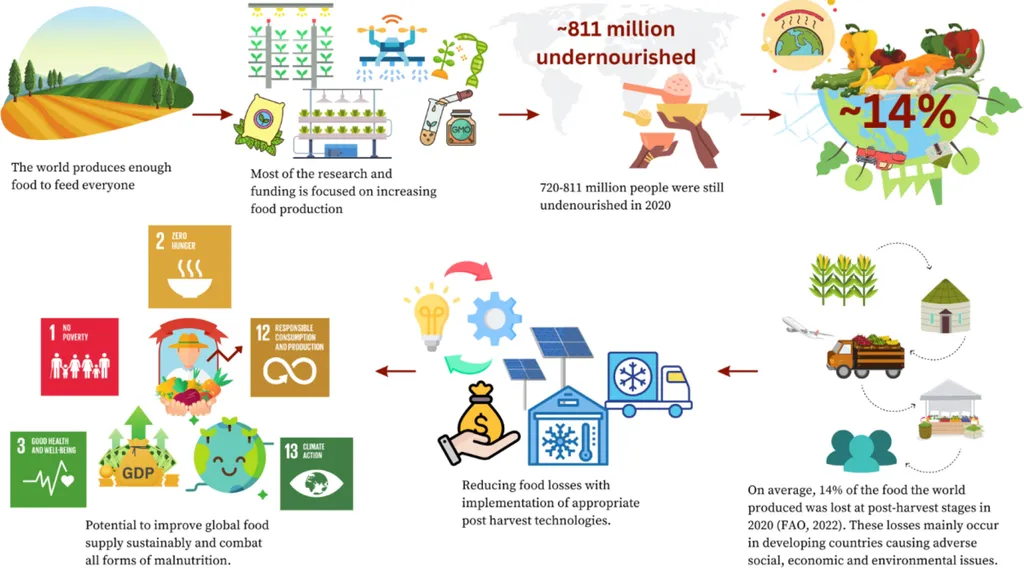
In the heart of rural agricultural communities, where the hum of refrigeration units is often absent, farmers face a silent crisis: post-harvest losses of perishable crops. These losses, driven by the lack of affordable cooling solutions, not only dent farmers’ livelihoods but also pose a significant challenge to food security. However, a recent study published in *Discover Materials* offers a glimmer of hope, demonstrating how locally available materials can be harnessed to create sustainable, energy-free cooling systems.
The research, led by C. S. Thamme Gowda from the Department of Mechanical Engineering at Vidyavardhaka College of Engineering, explores a modified pot-in-pot evaporative cooling system. This innovative design incorporates alternative porous media—sand-water, stone-water, and sponge-water mixtures—to optimize temperature regulation and humidity retention. Unlike conventional sand-based coolers, this system leverages material-driven thermal and hydraulic properties to enhance cooling efficiency.
The study’s findings are promising. Over a 24-hour period, the system achieved temperature reductions ranging from 2.4°C to 6.0°C from an ambient average of 24.38°C, with internal humidity levels maintained between 75% and 90%. These results, based on time-averaged readings from DHT22 sensors connected to an Arduino Uno, underscore the potential of low-cost, locally available materials in improving passive cooling efficiency.
“The beauty of this system lies in its simplicity and accessibility,” said Thamme Gowda. “By using materials that are readily available in rural communities, we can create a sustainable solution that addresses the critical issue of post-harvest losses.”
The commercial implications of this research are substantial. For the agriculture sector, which grapples with significant post-harvest losses due to inadequate storage facilities, this innovative cooling system offers a cost-effective and sustainable solution. By reducing losses, farmers can enhance their income and contribute to food security in their communities.
Moreover, the study’s findings open up new avenues for research and development in the field of passive cooling. As Thamme Gowda noted, “This is just the beginning. The exploratory findings motivate replicated testing and further optimization of the system.”
The research also highlights the importance of integrating local knowledge and resources into technological solutions. By doing so, we can create systems that are not only effective but also culturally and environmentally sustainable.
In the quest for sustainable food storage solutions, this study serves as a beacon of hope. It demonstrates that with a bit of creativity and a focus on local resources, we can make significant strides in reducing post-harvest losses and enhancing food security. As the world grapples with the challenges of climate change and food insecurity, such innovations are not just welcome but essential.