
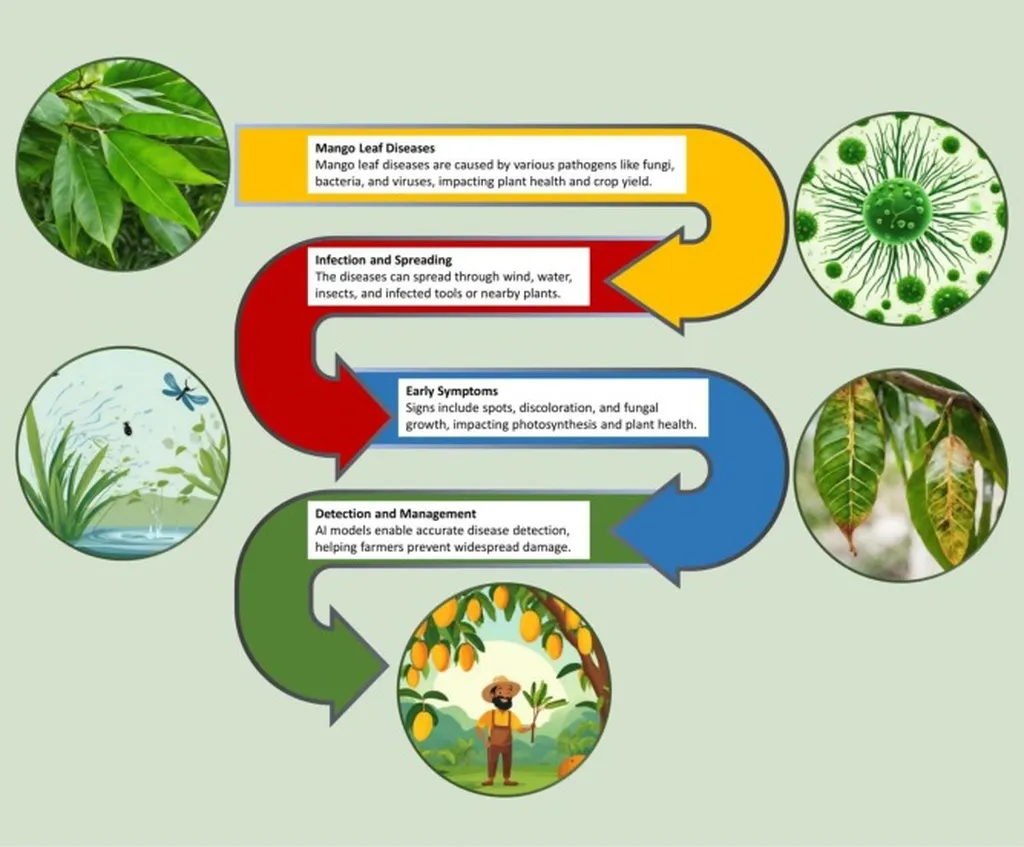
In the heart of Bangladesh’s lush mango orchards, a technological revolution is brewing, one that promises to reshape the future of agriculture and bolster the economy. A team of researchers, led by Salma N., has developed a cutting-edge hybrid model that combines the power of Convolutional Neural Networks (CNN) and Support Vector Machines (SVM) to detect mango leaf diseases with unprecedented accuracy. This innovative approach, published in the *Scientific Journal of King Faisal University: Basic and Applied Sciences*, could be a game-changer for farmers and the agriculture sector at large.
The model, trained on a dataset of 4000 images, can classify eight distinct mango leaf conditions, including Anthracnose, Bacterial Canker, and Powdery Mildew, with an impressive accuracy of 99.75%. This is a significant leap from existing methods, which often rely on the naked eye and experience of farmers, a process that is not only time-consuming but also prone to errors.
“Our model is designed to be robust and generalisable,” explains Salma N., the lead author of the study. “We incorporated rigorous pre-processing and data augmentation techniques to ensure that our model can perform well even with variations in image quality and lighting conditions.”
The implications of this research are vast. Mangoes are a major export commodity for many Asian countries, and diseases can cause significant losses in both productivity and quality. Early and accurate disease detection can help farmers take timely action, thereby reducing crop losses and improving yields. This, in turn, can have a positive impact on the economy, as higher yields mean more produce to export.
Moreover, the model’s high accuracy can also lead to more sustainable farming practices. By identifying diseases early, farmers can use targeted treatments, reducing the need for broad-spectrum pesticides. This not only benefits the environment but also reduces the cost of farming.
The research also highlights the potential of deep learning and machine learning in agriculture. As Salma N. puts it, “Our work is just the beginning. We believe that these technologies can be applied to other crops and diseases, paving the way for a new era of smart, sustainable agriculture.”
Indeed, the future of agriculture seems to be increasingly intertwined with technology. As this research shows, the synergistic use of different machine learning techniques can lead to breakthroughs that were previously unimaginable. It is a testament to the power of interdisciplinary research and the potential of technology to transform traditional industries.
In the coming years, we can expect to see more such innovations, as researchers continue to explore the intersection of agriculture and technology. The work of Salma N. and her team is a promising start, and it will be exciting to see how this field evolves in the future. One thing is clear: the future of agriculture is not just about growing crops; it’s about growing smarter.