
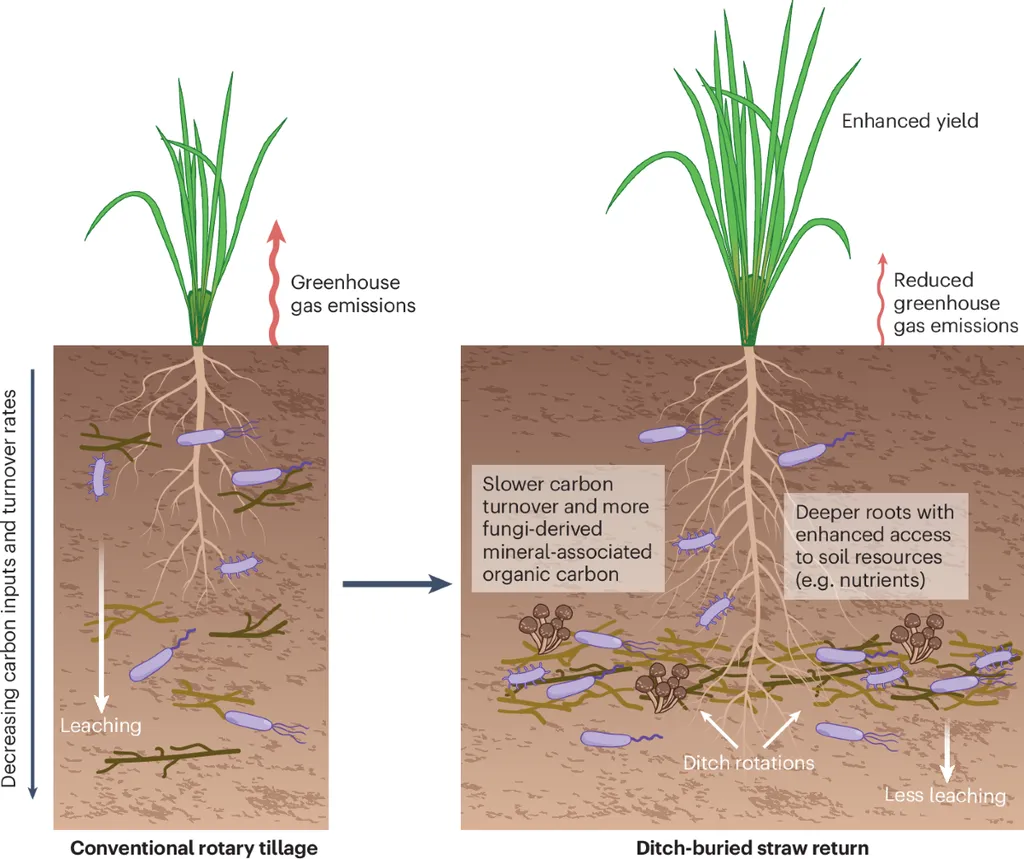
In the quest to bolster soil fertility and combat climate change, farmers and scientists have long recognized the importance of straw return—the practice of returning crop residues to the soil. A recent global meta-analysis published in *Frontiers in Microbiology* sheds new light on how this practice influences soil carbon dynamics, with significant implications for agricultural sustainability and carbon sequestration efforts.
The study, led by Somdee Somchanh of the Faculty of Environmental Science and Engineering at Kunming University of Science and Technology in China, synthesized data from 211 observations across 68 field studies worldwide. The focus was on hydrolytic carbon-degrading extracellular enzyme activities (Hy-EEAs), which play a pivotal role in soil carbon cycling.
“Straw return significantly enhances these enzyme activities, which in turn regulate below-ground carbon dynamics,” Somchanh explained. The research found that straw return increased Hy-EEAs by an average of 25%, with the exception of β-xylosidase, which remained unaffected. This enhancement was more pronounced with increased straw incorporation and decreased with longer experiment durations, particularly those lasting 10 years or more.
The study also revealed that straw return led to substantial increases in various soil carbon pools. Dissolved organic carbon, easily oxidizable carbon, light fraction organic carbon, particulate organic carbon, microbial biomass carbon, and soil organic carbon all saw notable boosts, ranging from 20% to 51% compared to no-straw-return treatments.
One of the most intriguing findings was the positive correlation between the response ratios of microbial biomass carbon and soil organic carbon storage with the response ratios of Hy-EEAs. This suggests that the stimulation of these enzymes by straw return plays a key role in regulating carbon dynamics below ground.
“These results highlight the importance of incorporating the relationships between soil carbon pools and Hy-EEAs into future biogeochemistry models,” Somchanh noted. Such models could improve predictions of carbon sequestration in agricultural soils, offering valuable insights for farmers and policymakers alike.
The commercial impacts of this research are substantial. For the agriculture sector, understanding how straw return affects soil carbon dynamics can lead to more informed practices that enhance soil fertility and sequester carbon, thereby mitigating climate change. Farmers can optimize their straw incorporation strategies to maximize these benefits, potentially increasing crop yields and soil health.
Moreover, the findings could influence the development of new agricultural technologies and practices aimed at improving carbon sequestration. By leveraging the insights from this study, agritech companies and researchers can innovate solutions that enhance soil carbon storage, contributing to more sustainable and resilient agricultural systems.
As the global push for sustainable agriculture intensifies, this research provides a crucial piece of the puzzle. By elucidating the mechanisms behind straw return’s impact on soil carbon, it paves the way for more effective strategies to combat climate change and improve agricultural productivity. The study not only advances our scientific understanding but also offers practical guidance for farmers and policymakers striving to create a more sustainable future.