
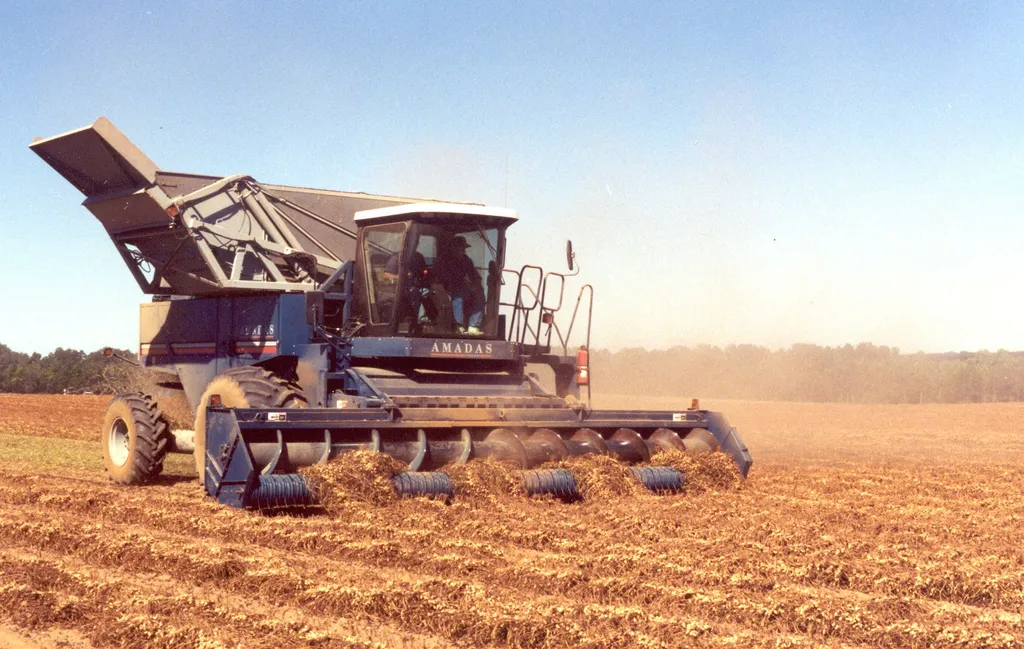
In the heart of Italy, a quiet revolution is taking place in the fields where peanuts are making a comeback. A recent study published in *Smart Agricultural Technology* is shedding light on the mechanics of peanut harvesting, offering insights that could boost efficiency and profitability for farmers. The research, led by Maura Sannino from the Department of Human Science and Quality of Life Promotion at San Raffaele Telematic University in Rome, delves into the intricate details of pod detachment forces in *Arachis hypogaea*, providing a roadmap for optimizing mechanical harvesting.
Peanuts, once a niche crop in Italy, are regaining popularity due to their nutritional value and agronomic benefits. However, efficient harvesting remains a challenge. The study explores how different planting densities and the use of *Azotobacter spp.* bacteria—a type of biofertilizer—affect yield, maturation, and the forces required to detach pods from the plant. This is crucial for minimizing harvest losses and improving overall productivity.
The research found that pod moisture content and peduncle length are key factors influencing the detachment forces between pods, peduncles, and vines. “We observed that the peduncle-vine connection is stronger than the pod-peduncle connection,” explains Sannino. “This means that during the digging phase, the pods remain firmly attached to the vines, but during separation, the pods detach more easily. This dual resistance profile is beneficial for efficient harvesting.”
The study also revealed that the application of *Azotobacter spp.* did not significantly impact yield or detachment forces, suggesting that other factors might be more influential in optimizing peanut production. However, the research did highlight that higher planting densities led to greater harvest losses, indicating that density management is a critical consideration for farmers.
One of the most promising aspects of this research is its potential to inform the development of new harvesting technologies. By providing quantitative data on the temporal variation of pod detachment forces, the study offers a robust foundation for manufacturers to create more efficient and scalable harvesting protocols. “Our findings offer operational benchmarks that can support the development of new experimentation protocols for peanut harvesting,” says Sannino. “This could enhance working efficiency and reduce field losses, ultimately benefiting the entire agriculture sector.”
The implications of this research extend beyond Italy, offering valuable insights for regions with similar agroecosystems. As the demand for sustainable and locally integrated supply chains grows, evidence-based cultivation strategies become increasingly important. By reintroducing peanut cultivation with a focus on optimal harvesting practices, farmers can tap into a lucrative market while contributing to a more sustainable agricultural future.
This study not only advances our understanding of peanut cultivation but also paves the way for innovative solutions that can drive the agriculture sector forward. As the world continues to seek sustainable and efficient farming practices, research like this serves as a beacon, guiding us toward a more productive and environmentally friendly future.