
In the lush, steep river valleys of subtropical Taiwan, where torrential rains and heavy sediment loads are the norm, riverbank erosion is a constant battle. But new research published in the *Journal of Hydrology: Regional Studies* offers hope for better understanding—and managing—this critical issue, with implications that stretch far beyond Taiwan’s borders.
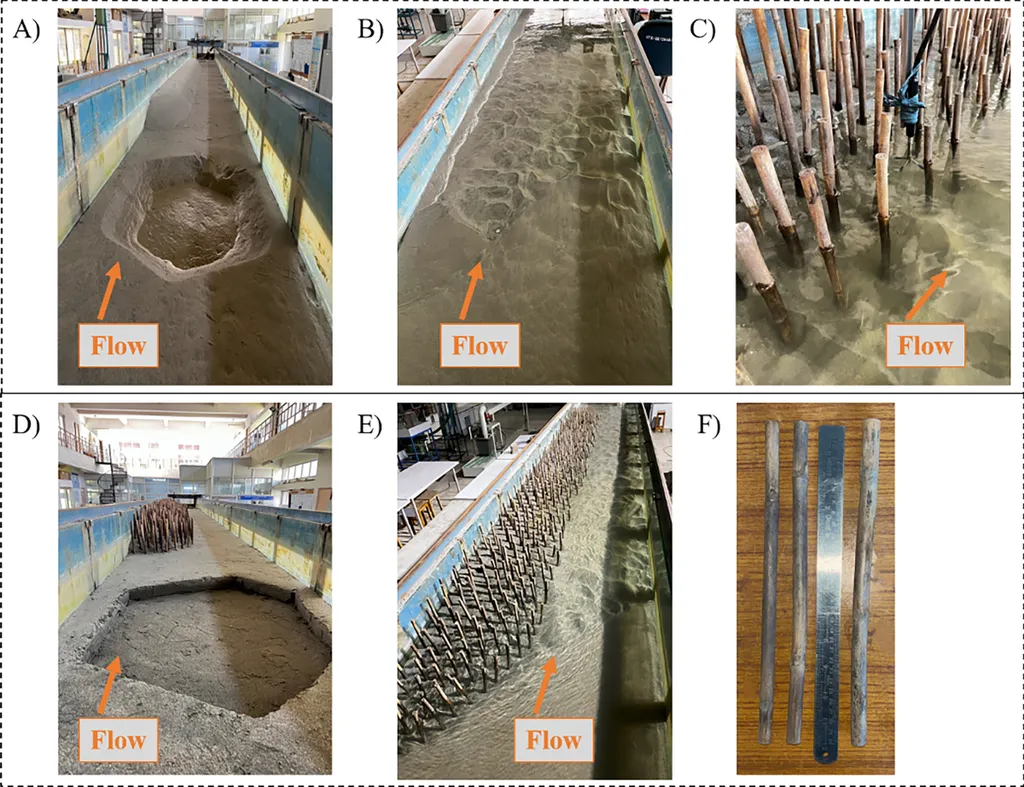
The study, led by Jin-Fu Li of the Taiwan Forestry Research Institute, delves into the intricate relationship between riparian vegetation and riverbank erosion. Using controlled flume experiments, Li and his team tested five different riverbank configurations, from completely bare to fully vegetated, and everything in between. Their findings could reshape how we approach riverbank stabilization, particularly in agriculture-dominated landscapes.
The results were striking. Fully vegetated riverbanks showed a 12.9% lower erosion ratio compared to non-vegetated banks, a clear testament to the stabilizing power of roots. “The presence of vegetation significantly reinforces the bank, acting as a natural barrier against erosion,” Li explains. But the story doesn’t end there. The study also revealed that the spatial continuity of vegetation plays a pivotal role. When bare gaps in the vegetation exceeded about one-third of the bank length, erosion rates and flow patterns mimicked those of non-vegetated banks. “Narrow gaps concentrated flow, leading to localized erosion, while wider gaps disrupted root connectivity, weakening the bank’s overall resistance,” Li notes.
For the agriculture sector, these insights are invaluable. Riverbank erosion can lead to significant loss of arable land, reduced water quality due to sediment runoff, and increased maintenance costs for irrigation systems. By strategically planting and maintaining riparian vegetation, farmers and land managers can enhance bank stability, reduce sediment loss, and potentially improve water quality. “This research underscores the importance of integrated land management practices that consider both above-ground vegetation and below-ground root systems,” Li says.
The study also highlights the need for tailored approaches. In regions with steep, fast-flowing rivers—like those in Taiwan—the benefits of vegetation are particularly pronounced. However, the specific configurations and species of vegetation may vary depending on local conditions. “Understanding these nuances is crucial for developing effective, site-specific strategies,” Li emphasizes.
Looking ahead, this research could pave the way for innovative agritech solutions. For instance, precision agriculture techniques could be adapted to optimize vegetation planting patterns along riverbanks, balancing erosion control with agricultural productivity. Additionally, remote sensing technologies could monitor vegetation health and root mass density, providing real-time data to inform management decisions.
In the broader context, this study is a reminder of the intricate interplay between natural systems and human activities. By harnessing the power of vegetation, we can mitigate erosion, protect valuable agricultural land, and foster more sustainable river management practices. As Li puts it, “Nature offers us powerful tools for addressing complex environmental challenges. It’s up to us to use them wisely.”