
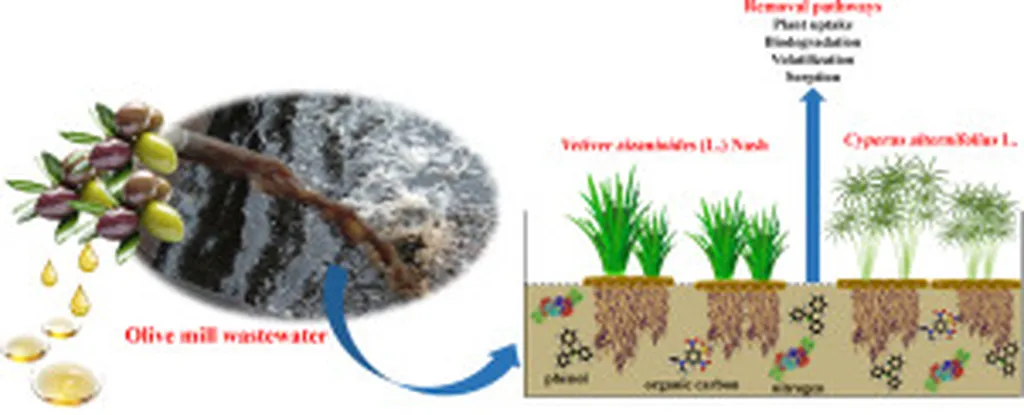
In the heart of Morocco, a humble grass is making waves in the world of wastewater treatment, offering a promising solution to a persistent environmental challenge. Vetiver grass, known for its hardiness and extensive root system, has been found to effectively remediate wastewater rich in polyphenols, a byproduct of olive oil production that poses significant environmental risks. This breakthrough research, published in *Scientific African*, could revolutionize wastewater management in the agriculture sector, particularly in regions where olive oil production is prevalent.
The study, led by Younes Gaga from the Laboratory of Biotechnology, Conservation and Valorization of Natural Resources (LBCVRN) at Sidi Mohamed Ben Abdellah University, demonstrates that Vetiveria zizanioides can thrive even under high contamination levels. The research team developed an innovative hybrid treatment system at the Fez wastewater plant, combining trickling filters, planted filters, and activated sludge with vetiver’s robust root system and active aeration. This approach addresses the limitations of conventional treatment methods, which struggle with high phenolic and organic loads.
“Our findings reveal that vetiver can remove up to 91% of chemical oxygen demand (COD), 87.5% of phenols, 94.1% of nitrogen, and 80.72% of phosphorus from wastewater,” says Gaga. “This is a significant advancement, as previous studies have not tested such high pollutant loads in a real-world setting.” The daily monitoring of multiple parameters over eleven days provided detailed insights into the pollutant removal dynamics, highlighting the resilience and phytoremediation capacity of vetiver.
The implications for the agriculture sector are substantial. Olive oil production generates large volumes of wastewater enriched in polyphenols, which can be harmful to the environment if not treated properly. Traditional treatment methods are often costly and inefficient, making them less accessible to small-scale producers. The vetiver-based system offers a scalable, cost-effective, and environmentally sustainable alternative. “This technology can be easily integrated into existing wastewater treatment facilities, reducing treatment costs and mitigating environmental impacts,” Gaga explains.
The research also paves the way for future developments in phytoremediation. By combining hybrid treatment systems with real-world application and high-load testing, the study advances current knowledge and supports municipalities and industries in improving wastewater management. As the agriculture sector continues to grapple with environmental challenges, innovative solutions like this vetiver-based system offer hope for a more sustainable future.
The study’s success in Morocco suggests that similar systems could be implemented in other regions with olive oil production, potentially transforming wastewater management practices globally. As the world seeks sustainable solutions to environmental challenges, the humble vetiver grass stands as a testament to the power of nature in addressing complex problems.