
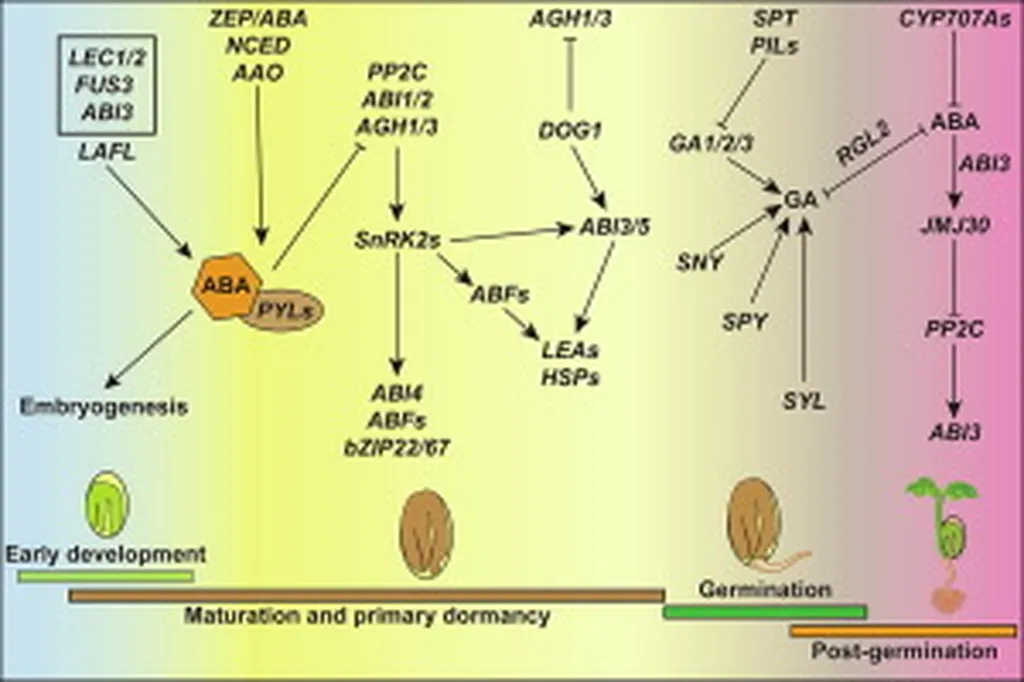
In the intricate dance of plant biology, a new study has uncovered a pivotal role for the tyrosine (Tyr) degradation pathway in regulating seed dormancy and germination, with significant implications for the agriculture sector. Published in the journal ‘Plants’, the research led by Chao Hu from the College of Bioscience and Biotechnology at Hunan Agricultural University, sheds light on how the final enzyme in this pathway, fumarylacetoacetate hydrolase (FAH), influences the gibberellin (GA) pathway, a critical regulator of seed dormancy and germination.
The study focused on the *SHORT-DAY SENSITIVE CELL DEATH 1* (*SSCD1*) gene in Arabidopsis, which encodes FAH. Previous research had shown that a mutant of this gene leads to the accumulation of Tyr metabolites and induces cell death under short-day conditions. Building on this, the current study revealed that *sscd1* seeds exhibit deep dormancy and hypersensitivity to paclobutrazol, a GA biosynthesis inhibitor, but not to abscisic acid (ABA), which induces seed dormancy.
“Our findings suggest that FAH deficiency in *sscd1* causes accumulation of Tyr metabolites, thereby disrupting GA biosynthesis and signaling,” explained Chao Hu, the lead author of the study. This disruption results in deep dormancy and hypersensitivity to paclobutrazol during germination, highlighting the important role of the Tyr degradation pathway in GA-mediated seed dormancy and germination.
The study also found that exogenous GA₃ could not completely rescue the dormancy or germination of *sscd1* seeds, indicating that the disruption in the GA pathway is significant. Moreover, the GA₃ level was reduced in imbibed *sscd1* seeds, consistent with the decreased expression of *GA3-oxidase 1*. The researchers further demonstrated that *SSCD1* acts upstream of *RGA-LIKE 2*, and that eliminating the accumulation of Tyr metabolites by inhibiting homogentisate dioxygenase, an enzyme upstream of FAH, completely rescued the phenotype of *sscd1* seeds.
The commercial implications of this research are substantial. Seed dormancy and germination are critical traits for crop yield and quality. Understanding the molecular mechanisms underlying these processes can lead to the development of new agricultural technologies and strategies to improve crop performance. For instance, manipulating the Tyr degradation pathway could potentially enhance seed germination rates and reduce dormancy, leading to more uniform and reliable crop establishment.
Furthermore, the study’s findings could pave the way for the development of new GA biosynthesis inhibitors or activators, which could be used to control seed dormancy and germination in a more targeted and precise manner. This could be particularly beneficial for the agriculture sector, where precise control over seed germination can lead to more efficient use of resources and improved crop yields.
In the broader context, this research underscores the importance of understanding the intricate web of plant metabolic pathways and their roles in regulating key physiological processes. As Chao Hu noted, “This study not only advances our understanding of the Tyr degradation pathway but also opens up new avenues for research into the regulation of seed dormancy and germination.”
The study’s findings are a testament to the power of plant science in driving agricultural innovation. As we continue to unravel the complexities of plant biology, we open up new possibilities for improving crop performance and ensuring food security in an increasingly challenging world. The research published in ‘Plants’ by Chao Hu and colleagues is a significant step in this direction, offering valuable insights into the molecular mechanisms regulating seed dormancy and germination, and highlighting the potential of the Tyr degradation pathway as a target for agricultural innovation.