
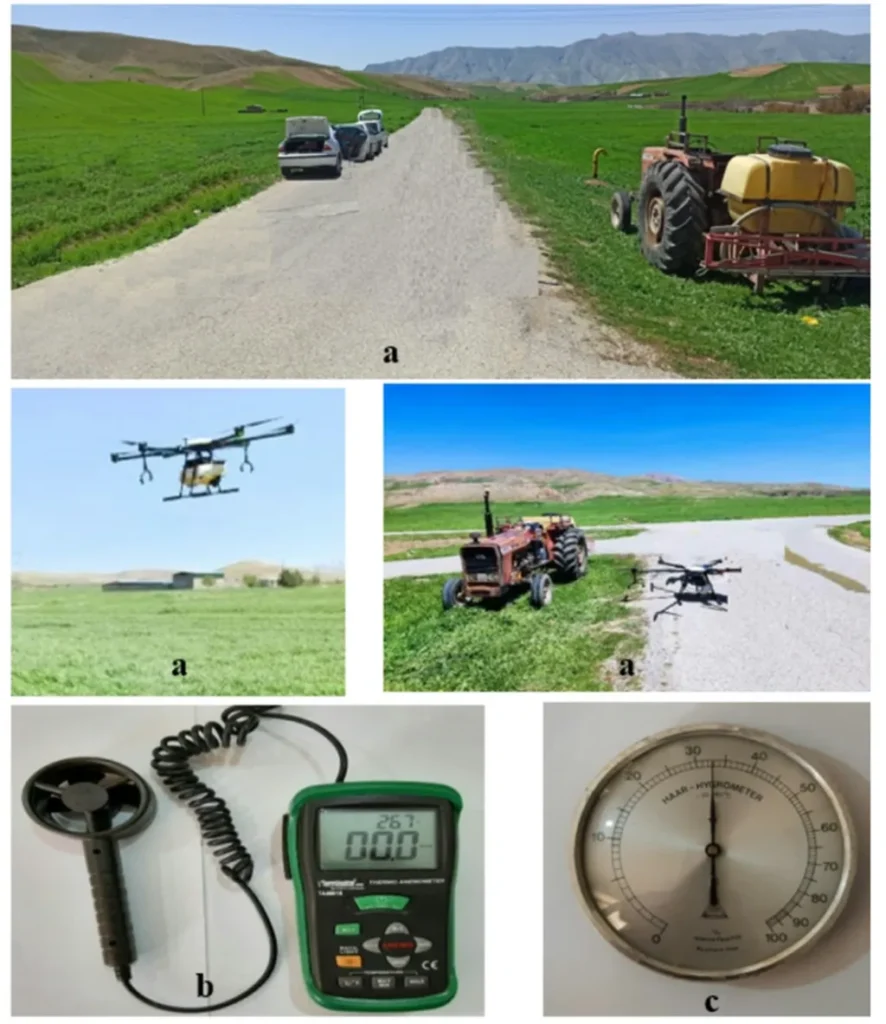
In the rapidly evolving world of agricultural technology, a new study published in *Scientific Reports* is shedding light on the performance of spraying drones compared to traditional boom sprayers. The research, led by Mojtaba Safaeinezhad from the Department of Agricultural Machinery and Mechanization Engineering at the University of Khuzestan, offers valuable insights into the efficiency and effectiveness of these modern tools, potentially reshaping how farmers approach pesticide application.
The study, which involved field experiments at varying operational speeds, reveals that spraying drones and boom sprayers perform differently under different conditions. Drone speeds were tested at 21.6, 26.2, and 27.0 km/h, while boom sprayers were evaluated at 4.39, 6.00, and 8.57 km/h. The results showed that the lowest deposition rate (2.67%) occurred at the highest drone speed, whereas the highest deposition (3.85%) was observed for the boom sprayer at its lowest speed. These findings highlight the nuanced performance of each system, which could influence future adoption and investment decisions in the agriculture sector.
One of the most significant findings was the difference in spray quality and droplet uniformity. “Among all treatments, drones achieved a superior quality index (QI) of 1.27 compared to 3.07 for boom sprayers,” noted Safaeinezhad. This superior QI indicates that drones may offer better droplet uniformity and spray quality, which are critical factors in effective pesticide application. However, the study also identified challenges, such as lower deposition rates and higher drift levels at greater speeds, which need to be addressed to fully realize the potential of spraying drones.
The commercial implications of this research are substantial. As labor shortages and limited field accessibility continue to challenge farmers, the operational flexibility of spraying drones becomes increasingly attractive. “This study provides a comprehensive performance assessment of both systems, which is crucial for informed decision-making regarding their application, development, and investment potential,” Safaeinezhad explained. The findings suggest that while drones may not yet fully replace boom sprayers, they offer a promising alternative that could enhance efficiency and effectiveness in pesticide application.
Looking ahead, this research could shape future developments in agricultural mechanization. The superior spray quality of drones, coupled with their flexibility, positions them as a valuable tool in modern farming practices. However, addressing the challenges of deposition rates and drift will be essential to maximize their benefits. As the agriculture sector continues to embrace technological advancements, studies like this one will play a pivotal role in guiding the adoption and optimization of new technologies.
In conclusion, the study published in *Scientific Reports* offers a detailed comparison of spraying drones and boom sprayers, highlighting both their strengths and areas for improvement. As farmers and agribusinesses consider their options, this research provides a crucial foundation for making informed decisions that could shape the future of agricultural practices.