
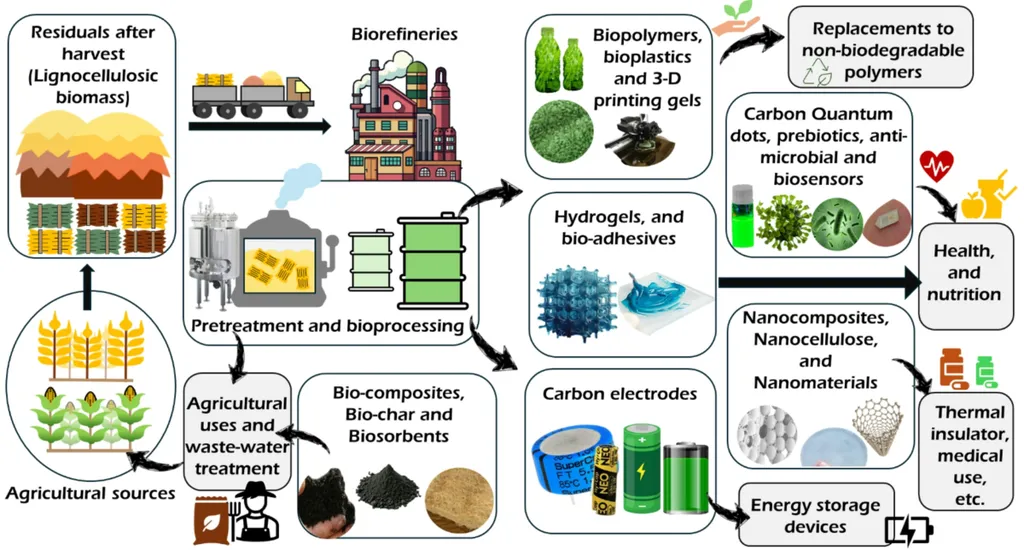
In a significant stride towards optimizing biorefinery processes, researchers have harnessed the power of machine learning to predict and enhance the production of microcrystalline cellulose (MCC) and cellulose nanocrystals (CNC) from Miscanthus biomass. This innovative approach, detailed in a study published in *Industrial Crops and Products*, not only promises to streamline industrial processes but also underscores the potential of advanced technologies in revolutionizing the agriculture sector.
The study, led by Sheng Wang from the Hunan Engineering Laboratory of Miscanthus Ecological Applications at Hunan Agricultural University, employed a sophisticated sampling strategy that integrated PCA-based K-means clustering with centroid-proximity screening. This method systematically identified genetically diverse clones of Miscanthus sacchariflorus and M. lutarioriparius from a nationwide collection. The research team then combined these clones with 12 cultured polyploid M. lutarioriparius to form the sample set for their model.
Analysis of variance (ANOVA) and summary statistics revealed that polyploid M. lutarioriparius was the optimal biomass feedstock for MCC and CNC production, exhibiting superior yields and enhanced physical properties. “This finding is crucial as it highlights the potential of polyploid Miscanthus as a high-quality feedstock for biorefinery applications,” Wang noted.
The study further identified that cellulose content, crystallinity index, and degree of polymerization positively influenced MCC/CNC yields and their physical properties, while other components had a negative impact. Leveraging these insights, the researchers employed three machine learning algorithms to develop predictive models. Among these, the extremely randomized tree regression (ETR) model demonstrated remarkable robustness and superior predictive accuracy, with R2train values exceeding 0.88 and R2test values above 0.87.
Based on the MCC and CNC yield data, four superior germplasm resources were selected, with G07 exhibiting the highest performance, boasting an MCC yield of 39.55% and a CNC yield of 31.64%. This research not only provides high-throughput tools for forecasting MCC and CNC production but also highlights chromosome doubling as an effective strategy for enhancing biomass quality.
The implications of this research are far-reaching for the agriculture sector. By optimizing the production of MCC and CNC, which are valuable bioproducts used in various industries, including pharmaceuticals, cosmetics, and food, this study paves the way for more sustainable and competitive biorefinery systems. “The integration of machine learning in biorefinery processes represents a paradigm shift, enabling us to maximize resource efficiency and minimize waste,” Wang explained.
As the agriculture sector continues to evolve, the adoption of such advanced technologies will be crucial in meeting the growing demand for sustainable and high-quality bioproducts. This research not only showcases the potential of Miscanthus as a feedstock but also underscores the importance of genetic diversity and advanced analytical techniques in driving innovation in the field.
The study, published in *Industrial Crops and Products*, was led by Sheng Wang from the Hunan Engineering Laboratory of Miscanthus Ecological Applications at Hunan Agricultural University, in collaboration with the Hunan Branch of the National Energy R & D Center for Non-Food Biomass and Yuelushan Laboratory. This groundbreaking research is poised to shape future developments in the field, offering a blueprint for the integration of machine learning and biorefinery processes to enhance productivity and sustainability.