
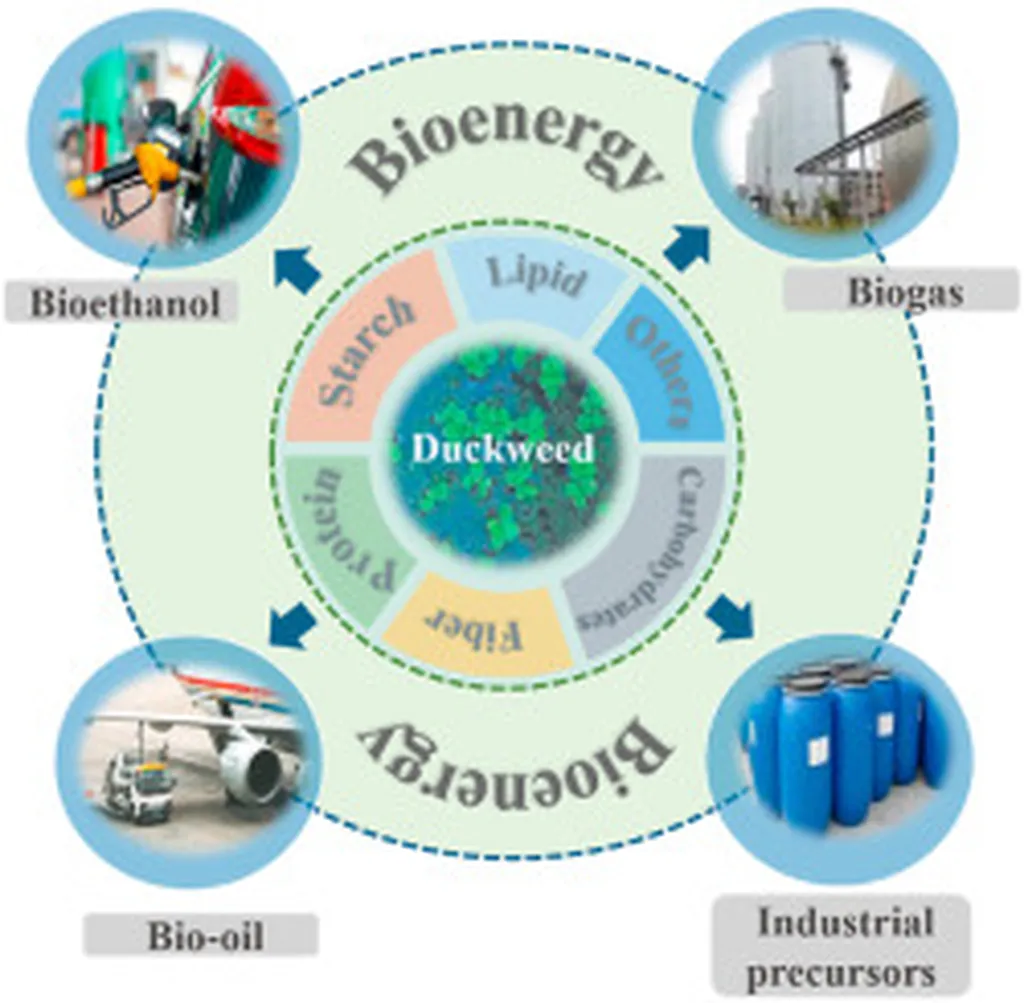
In the quest for sustainable bioenergy feedstocks, duckweed has long been a promising candidate, and new research is shedding light on how to maximize its potential. A recent study published in *Industrial Crops and Products* reveals that optimizing light intensity and temperature can significantly boost biomass, starch, and protein accumulation in duckweed, offering a scalable framework for industrial cultivation.
The study, led by Md. Fakhrul Islam of the State Key Laboratory of Freshwater Ecology and Biotechnology at the Chinese Academy of Sciences, focused on *Lemna trisulca*, a species of duckweed known for its rapid growth and adaptability. By varying light intensities from 3000 to 20,000 lux and temperatures from 18°C to 31°C, the researchers discovered that both factors play a crucial role in enhancing the plant’s growth and yield.
“Our findings demonstrate that by fine-tuning these environmental conditions, we can significantly increase the biomass and starch content of duckweed,” Islam said. The study found that the highest biomass yield occurred at 20,000 lux and 28°C, with a peak biomass of 796.7 g/m² and 792.5 g/m², respectively. Starch yield was maximized at 12,000 lux, reaching 348.8 g/m², with starch content comprising 51.8% of the dry biomass. Protein accumulation peaked at 15,000 lux and 25°C, yielding 88.5 g/m².
These results are not just academically significant; they have substantial commercial implications for the agriculture and bioenergy sectors. Duckweed’s ability to accumulate high levels of starch and protein under optimized conditions makes it an attractive feedstock for biofuel production and other industrial applications. The study provides a practical blueprint for developing energy-efficient cultivation systems that can produce starch-rich biomass without compromising overall growth performance.
The research also highlights the potential for duckweed to be integrated into existing agricultural systems, offering a sustainable alternative to traditional crops. As the demand for renewable energy sources continues to grow, the ability to optimize duckweed cultivation could play a pivotal role in meeting these needs.
“This study offers a scalable framework for industrial cultivation, which could revolutionize the way we think about sustainable bioenergy production,” Islam noted. The findings suggest that by leveraging environmental factors, we can enhance the productivity of duckweed, making it a viable option for large-scale bioenergy projects.
As the agriculture sector continues to evolve, the insights from this research could pave the way for innovative approaches to crop cultivation and bioenergy production. By optimizing light and temperature conditions, farmers and bioenergy producers can maximize the potential of duckweed, contributing to a more sustainable and efficient agricultural future.
The study, published in *Industrial Crops and Products*, was led by Md. Fakhrul Islam, affiliated with the State Key Laboratory of Freshwater Ecology and Biotechnology at the Chinese Academy of Sciences and the University of Chinese Academy of Sciences. The research offers a promising path forward for the agricultural and bioenergy industries, demonstrating the potential of duckweed as a sustainable and efficient feedstock for the future.