
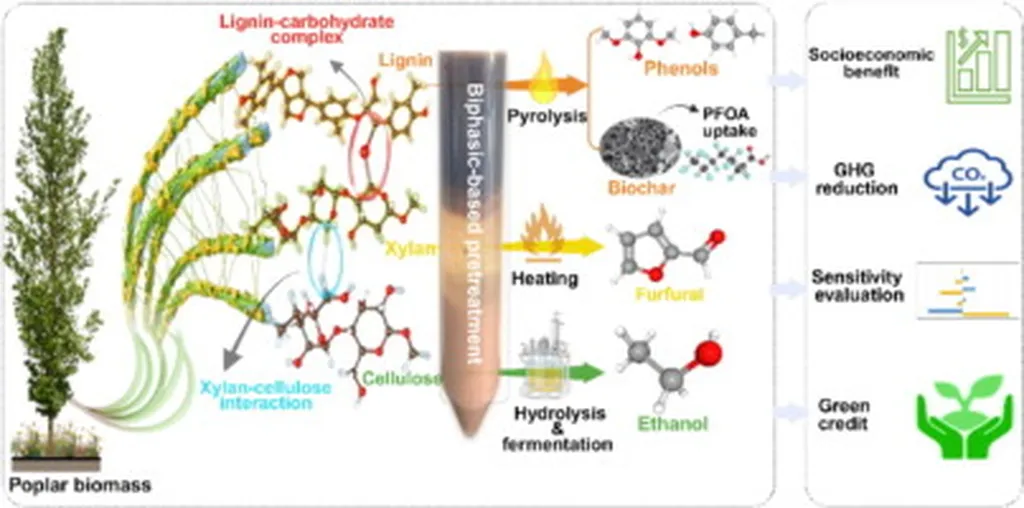
In a significant stride towards sustainable agriculture and bio-based industries, researchers have developed an integrated poplar biorefinery approach that transforms poplar biomass into a range of valuable bio-based chemicals, fuels, and lignin-derived products. This innovative method, detailed in a recent study published in the *Biofuel Research Journal*, not only promises substantial environmental benefits but also presents compelling economic opportunities for the agriculture sector.
The study, led by Meysam Madadi from the Key Laboratory of Industrial Biotechnology at Jiangnan University in China, employs a mild biphasic pretreatment process that efficiently fractionates poplar biomass. This process achieves remarkable results: 83.2% delignification, 95.2% xylan removal, and minimal cellulose loss of just 7.8%. The pretreatment paves the way for high-yield one-pot furfural production, reaching 68.5% yield, or 11.3 g/L.
One of the most promising aspects of this research is the production of a bio-solvent mixture through enzymatic hydrolysis and fermentation. The process utilizes Clostridium acetobutylicum to produce a solvent mixture containing 16.2 g/L, with butanol making up 10.5 g/L. Butanol is a valuable bio-based solvent with applications in various industries, including pharmaceuticals, cosmetics, and biofuels.
“The integration of these processes into a single biorefinery framework not only enhances the economic viability but also maximizes the utilization of poplar biomass,” said Meysam Madadi, the lead author of the study. This holistic approach ensures that every component of the poplar biomass is utilized, minimizing waste and maximizing output.
The study also highlights the potential environmental and economic benefits of scaling up this biorefinery approach. Processing 140 million metric tons of poplar biomass annually could avoid approximately 64.12 million metric tons of CO2-equivalent emissions. Economically, this could generate an estimated USD 2.97 billion in annual socioeconomic benefits. The financial viability is further supported by a projected aggregate net present value of USD 65.7 billion for full national implementation.
The research underscores the importance of biomass availability as a dominant factor influencing emission reduction and economic outcomes. This finding emphasizes the need for robust agricultural practices and sustainable forestry management to ensure a steady supply of poplar biomass.
The implications of this research extend beyond the immediate economic and environmental benefits. It sets a precedent for future developments in the biorefinery sector, demonstrating the feasibility of converting agricultural residues into high-value products. This could inspire similar initiatives in other regions and with different types of biomass, fostering a more sustainable and circular economy.
As the world grapples with the challenges of climate change and the need for sustainable practices, this study offers a beacon of hope. By transforming poplar biomass into valuable bio-based products, it not only reduces greenhouse gas emissions but also creates new economic opportunities for the agriculture sector. The research published in the *Biofuel Research Journal* by Meysam Madadi and his team at Jiangnan University represents a significant step forward in the quest for sustainable and economically viable biorefinery solutions.