
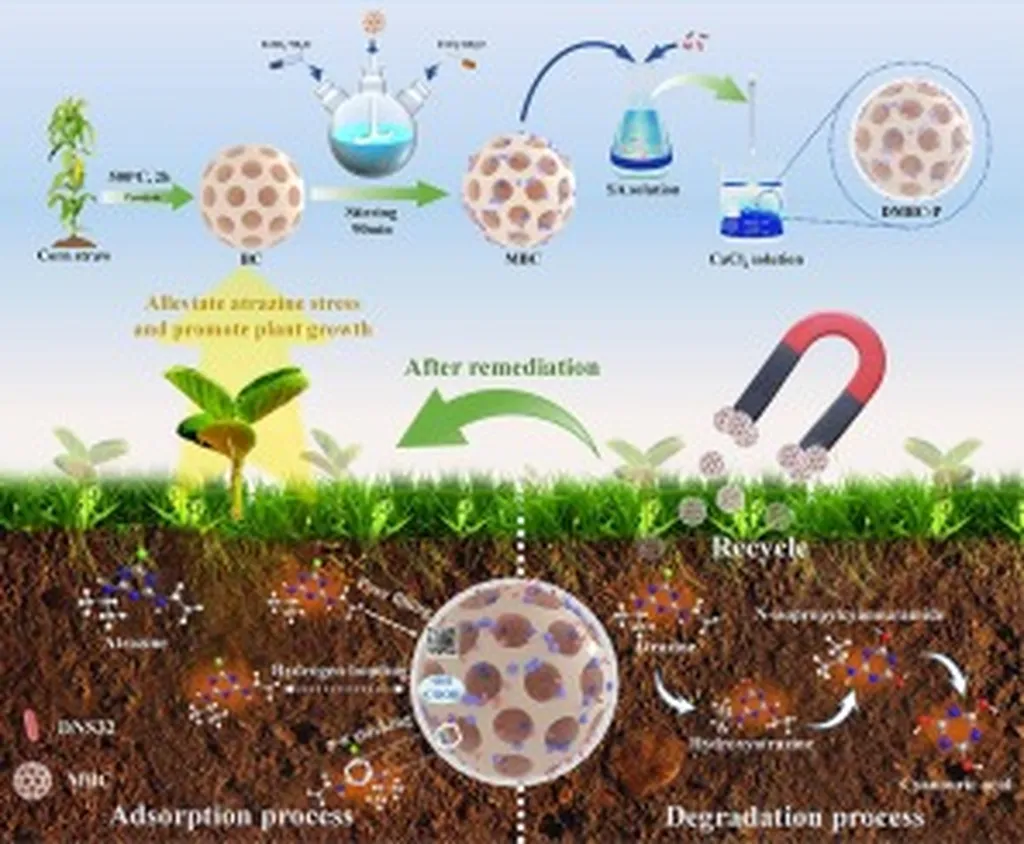
In the heart of Northeast China’s black soil region, a groundbreaking study has unveiled a promising solution to two pressing agricultural challenges: atrazine contamination and soil carbon sequestration. The research, led by Zhichao Kang from the State Key Laboratory of Black Soils Conservation and Utilization at the Chinese Academy of Sciences, introduces a novel approach that combines the power of a specific bacterium, Paenarthrobacter sp. KN0901, with biochar to enhance soil health and productivity.
The study, published in the journal ‘Industrial Crops and Products’, reports that the KN0901-biochar hybrid system achieved a remarkable 93.4% atrazine removal efficiency and increased soil organic carbon content by 6.0% over a two-month field experiment. This synergistic effect not only addresses the critical issue of atrazine contamination but also boosts soil fertility, offering a techno-economically feasible strategy for sustainable agriculture.
Atrazine, a widely used herbicide, has long been a concern due to its persistence in the environment and potential health risks. The KN0901-biochar system provides a novel way to degrade this contaminant while simultaneously enhancing soil carbon storage. “The biochar acts as a microhabitat that encourages microbial colonization and enriches lignocellulolytic genes,” explains Kang. “Meanwhile, the strain KN0901 stimulates key microbial taxa involved in organic matter turnover, significantly upregulating enzymes critical to carbon cycling.”
The implications for the agriculture sector are substantial. By improving soil health and fertility, this hybrid system can lead to increased crop yields and reduced reliance on chemical inputs. Moreover, the enhanced carbon sequestration capabilities can contribute to mitigating climate change by reducing atmospheric carbon dioxide levels.
The study’s findings suggest that the KN0901-biochar system could be a game-changer for sustainable agriculture. “This research provides a novel approach to addressing multiple agricultural challenges simultaneously,” says Kang. “It offers a promising strategy for reducing pollution, improving soil fertility, and advancing the long-term green development of agriculture.”
As the global push for sustainable and regenerative agriculture intensifies, innovations like the KN0901-biochar hybrid system are poised to play a pivotal role. By harnessing the power of microbial communities and biochar, this research paves the way for more resilient and productive agricultural systems, ultimately benefiting farmers, consumers, and the environment alike.
The research, led by Zhichao Kang from the State Key Laboratory of Black Soils Conservation and Utilization at the Chinese Academy of Sciences, was published in the journal ‘Industrial Crops and Products’.