
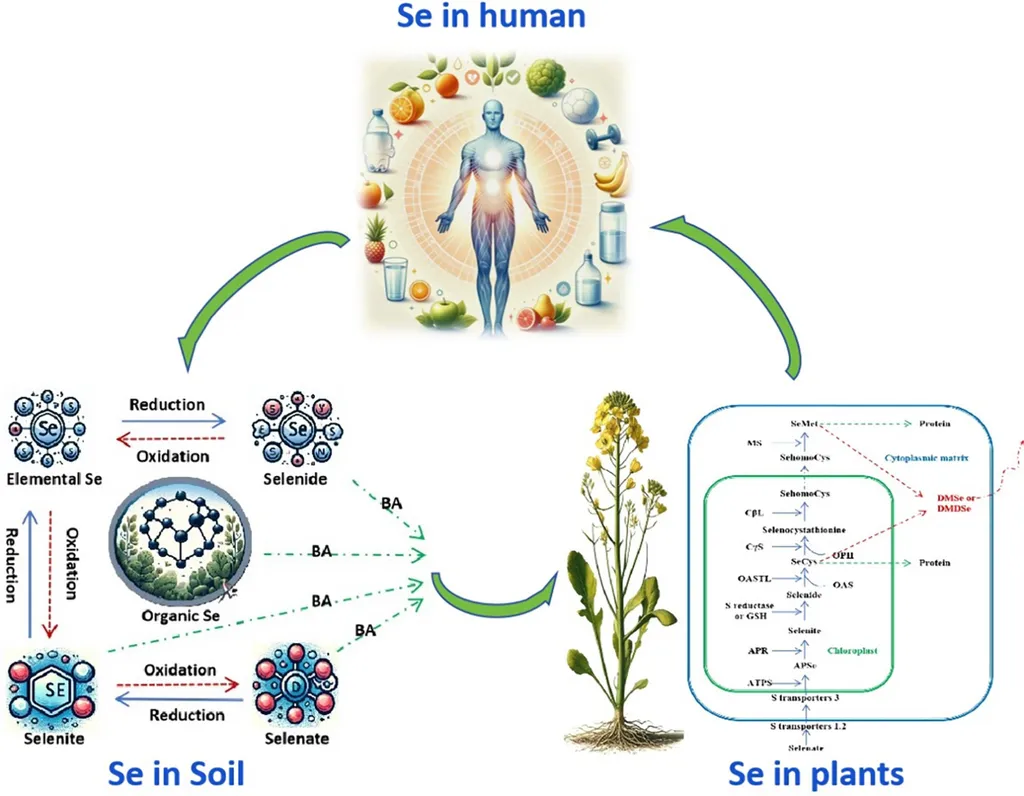
In the quest to combat global selenium (Se) deficiency, a team of researchers led by Lixia Wang from the Sanya Research Institute and the Institute of Tropical Bioscience and Biotechnology at the Chinese Academy of Tropical Agricultural Sciences has published a comprehensive review in *Frontiers in Plant Science*. The study delves into the intricacies of selenium biofortification in horticultural crops, offering a beacon of hope for improving human nutrition and reshaping agricultural practices.
Selenium, an essential element for humans, plays a pivotal role in thyroid hormone metabolism, immune system regulation, and antioxidant capacity. Yet, over 1 billion people worldwide suffer from Se deficiency, making the production of Se-fortified crops a pressing necessity. The review highlights the potential of biofortification—enhancing the nutritional quality of crops through agronomic practices and genetic improvements—to address this critical health issue.
The research explores recent advancements in Se biofortification technologies, focusing on soil and foliar application methods. It also examines the physiological processes and genetic mechanisms underlying Se uptake, transport, and assimilation in horticultural crops. One of the key findings is the significant variation in crops’ ability to uptake Se, a factor influenced by soil pH. This insight could revolutionize agricultural practices, enabling farmers to optimize Se levels in their crops more effectively.
“Understanding the genetic and physiological mechanisms of Se uptake and assimilation is crucial for developing targeted biofortification strategies,” said Wang. This knowledge could lead to the development of new crop varieties with enhanced Se uptake capabilities, benefiting both farmers and consumers.
The study also discusses the effectiveness of different Se-salts in regulating Se levels in crops, with a special emphasis on the mechanisms involved. This information could guide the agricultural industry in selecting the most appropriate Se-salts for biofortification, ensuring optimal results.
The commercial implications of this research are substantial. By improving the nutritional quality of horticultural crops, biofortification can enhance the market value of these products, opening up new opportunities for farmers and agribusinesses. Moreover, it can contribute to global health initiatives, addressing Se deficiency and its associated health risks.
The research published in *Frontiers in Plant Science* by Wang and her team not only advances our understanding of Se biofortification but also paves the way for innovative agricultural practices. As the world grapples with the challenges of food security and nutrition, this study offers a promising solution, highlighting the potential of biofortification to transform the agriculture sector and improve human health.
In the words of Wang, “This research is a stepping stone towards a future where biofortified crops play a significant role in addressing global health concerns.” The journey towards this future has begun, and the agriculture sector is poised to reap the benefits.