
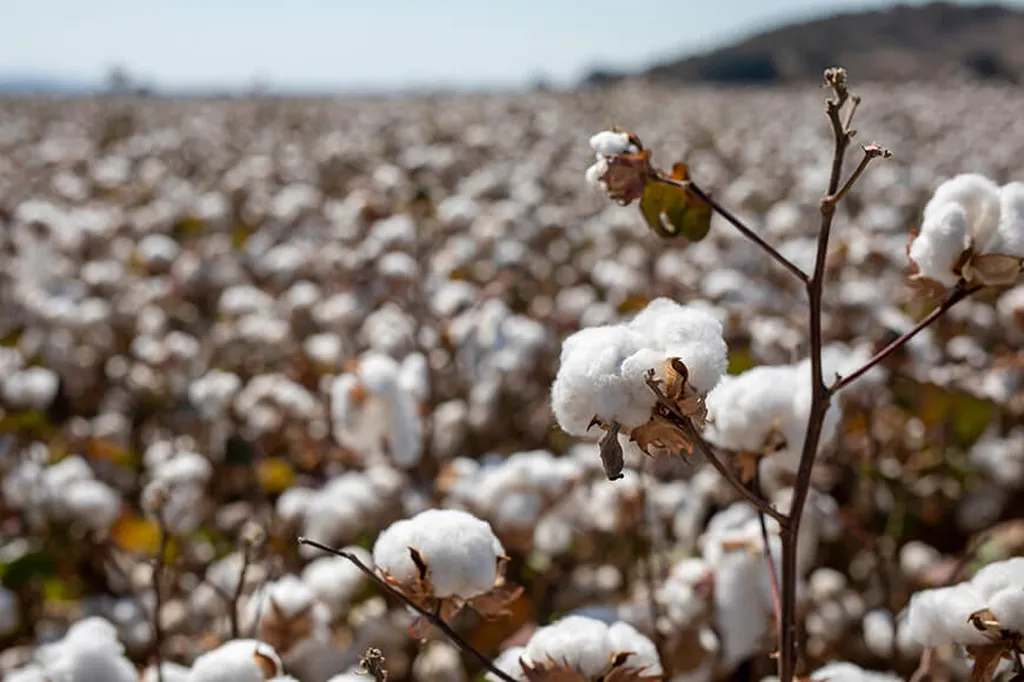
In the heart of cotton country, where the white gold is king, a breakthrough in defoliation research is set to revolutionize the way farmers prepare their crops for harvest. A recent study published in *Industrial Crops and Products* has uncovered the intricate dance of hormones that dictates how cotton plants shed their leaves, a crucial step in mechanized harvesting. The research, led by Yichi Zhang from the College of Agronomy and Biotechnology at China Agricultural University, sheds light on the role of soil moisture and plant hormones in the defoliation process, offering promising avenues for improving harvest efficiency and crop yield.
Cotton farmers have long relied on chemical defoliants like thidiazuron (TDZ) to ready their crops for machine harvest. However, the effectiveness of these chemicals has been at the mercy of environmental conditions, particularly soil moisture. “The optimal soil moisture for TDZ-induced defoliation is a delicate balance,” explains Zhang. “Too little or too much water can significantly hinder the defoliation process, leading to increased labor costs and reduced yield.”
The study found that the sweet spot for soil moisture is between 30-40% of field capacity (FC). At this range, the plant hormones auxin (IAA) and abscisic acid (ABA) work in concert to trigger leaf abscission. Under these conditions, IAA levels in the leaf decrease while ABA levels increase, signaling the plant to shed its leaves. The study also revealed that the flow of these hormones within the plant changes dramatically, with IAA flux decreasing in the petiole (the stalk that attaches the leaf to the stem) and increasing in the main stem, while ABA flux increases in both.
However, when soil moisture is at 95-100% FC, TDZ’s effectiveness is significantly reduced. The study found that under these conditions, TDZ does not alter the levels or flux of IAA and ABA, leaving the plant’s leaves firmly in place.
The implications for the agriculture sector are substantial. By understanding the hormonal interplay that governs defoliation, farmers can better time their application of defoliants, ensuring optimal soil moisture conditions and maximizing harvest efficiency. Moreover, the study’s findings could pave the way for the development of cotton varieties with improved defoliation characteristics, reducing the need for chemical interventions and lowering production costs.
The study also employed RNA sequencing to identify a plethora of genes related to the synthesis, metabolism, and transport of IAA and ABA. These genes could serve as targets for genetic modification, enabling breeders to develop cotton plants that shed their leaves more readily, even under suboptimal conditions.
“This research is a significant step forward in our understanding of chemical defoliation in cotton,” says Zhang. “It offers a roadmap for improving harvest efficiency and could have a profound impact on the agriculture sector.”
As the cotton industry grapples with the challenges of climate change and labor shortages, this study provides a beacon of hope. By harnessing the power of plant hormones and genetic modification, farmers can secure the future of this vital crop, ensuring a steady supply of cotton for the global market. The research, published in *Industrial Crops and Products* and led by Yichi Zhang from the College of Agronomy and Biotechnology at China Agricultural University, is a testament to the power of scientific inquiry in driving agricultural innovation.