
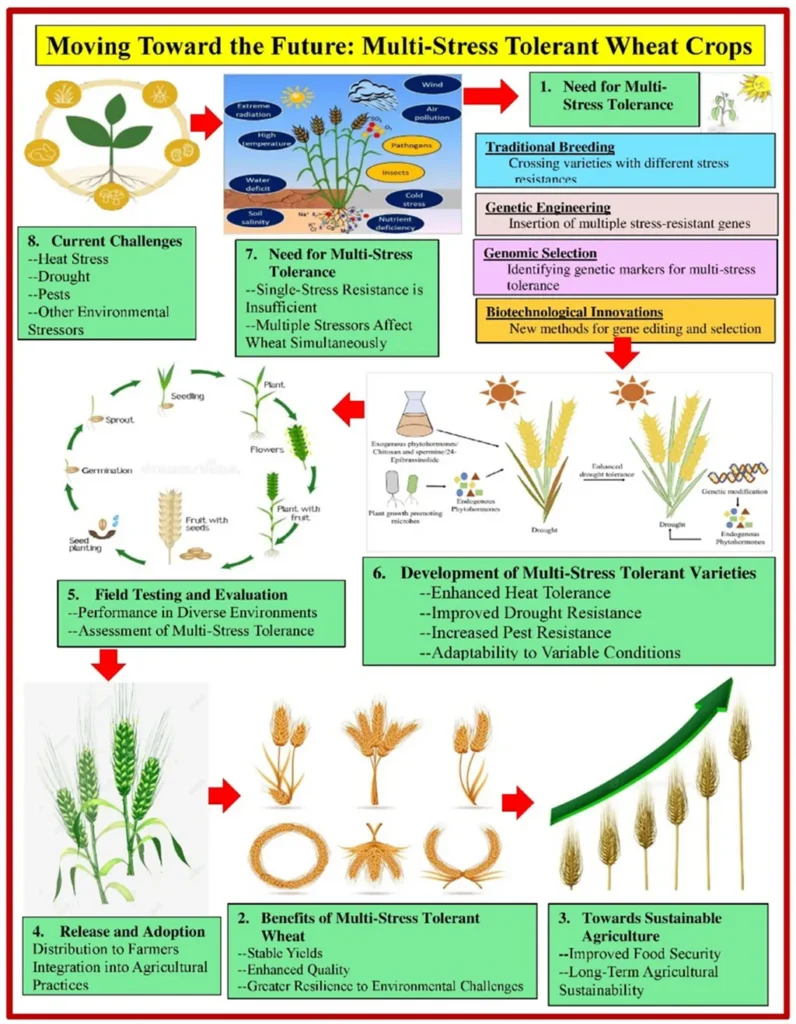
In the face of escalating global temperatures, the agricultural sector is grappling with the severe impacts of heat stress on staple crops. A recent study published in the *FUUAST Journal of Biology* and led by Feroz Gul Nizamani from the Department of Plant Breeding & Genetics at Sindh Agriculture University, Tando Jam, Pakistan, sheds light on the response of wheat genotypes to heat stress under different sowing conditions. The findings could have significant implications for wheat cultivation in heat-affected regions, particularly in Pakistan.
The research evaluated various wheat genotypes under two sowing dates: a normal planting date on November 25 and a delayed planting date on December 25, 2015. The delayed planting was intended to simulate summer stress conditions. The study revealed significant differences in genotype performance under normal and high-temperature conditions, highlighting the potential for breeding heat-tolerant wheat varieties.
“Our findings indicate that certain wheat genotypes, such as Imdad-05, NIA-Sarang, and TD-1, exhibit remarkable resilience to heat stress,” said Nizamani. “These genotypes showed minimal reductions in key traits under heat stress conditions, suggesting their suitability for cultivation in regions prone to high temperatures.”
The study observed a decline in various physico-yield traits due to delayed planting, underscoring the adverse effects of heat stress. On average, physical maturity, flag leaf area, specific flag leaf weight, grain spike-1, grain weight spike-1, 1000-grain weight, grain yield plant-1, organic yield plant-1, crop index, relative water content, and cell membrane stability decreased by 7.01%, 31.38%, 20.63%, 20.50%, 37.93%, 30.63%, 37.87%, 31.62%, 9.38%, 16.95%, and 10.96%, respectively, under heat stress conditions.
Conversely, cultivars like Khirman and AS-2002 exhibited significant declines under heat stress, indicating their susceptibility to high temperatures. The remaining genotypes were found to be moderately heat stress-tolerant.
The commercial implications of this research are substantial. With wheat being a staple crop in Pakistan and many other countries, the development of heat-tolerant varieties could enhance food security and economic stability. Farmers could benefit from higher yields and more reliable harvests, even in the face of rising temperatures.
“This research opens up new avenues for breeding programs aimed at developing heat-tolerant wheat varieties,” Nizamani added. “By identifying and utilizing resilient genotypes, we can better equip farmers to cope with the challenges posed by climate change.”
The study’s findings could also influence agricultural policies and practices, encouraging the adoption of heat-tolerant crops and sustainable farming techniques. As the world continues to grapple with the effects of global warming, such research becomes increasingly vital for ensuring food security and agricultural sustainability.
In the broader context, this research could shape future developments in agritech, particularly in the realm of crop breeding and genetic engineering. The identification of heat-tolerant genotypes paves the way for targeted breeding programs and the potential development of genetically modified crops that can withstand extreme temperatures.
As the agricultural sector continues to evolve, the integration of such scientific insights will be crucial for adapting to climate change and ensuring the resilience of global food systems. The study published in the *FUUUAST Journal of Biology* and led by Feroz Gul Nizamani from the Department of Plant Breeding & Genetics at Sindh Agriculture University, Tando Jam, Pakistan, represents a significant step in this direction, offering hope for a more sustainable and secure agricultural future.