
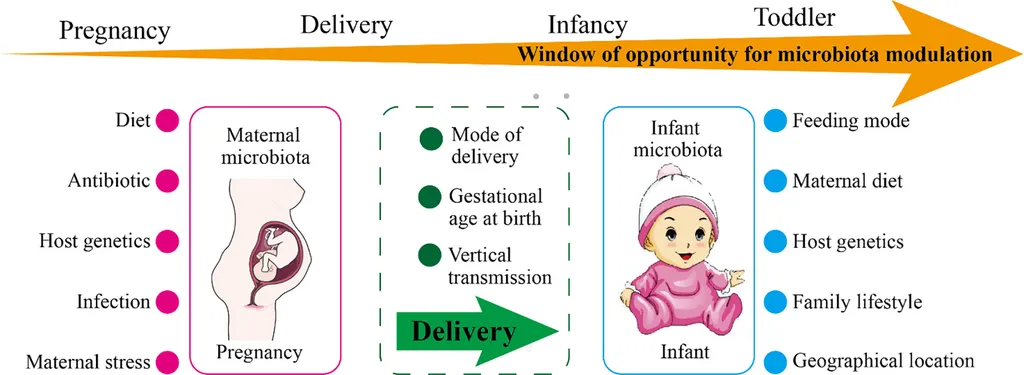
In the intricate world of neonatal health, the gut microbiome plays a pivotal role, influencing everything from digestion to immune system development. A recent study published in *Frontiers in Microbiology* has shed new light on how microbial communities in newborns produce short-chain fatty acids (SCFAs), compounds crucial for infant health. Led by Payam Hosseinzadeh Kasani from the Department of Pediatrics at Kangwon National University Hospital, the research employed advanced machine learning techniques to unravel the complexities of neonatal gut microbiota, offering insights that could reshape our understanding of early-life metabolic health.
The study recruited 71 mother-infant pairs, collecting meconium samples within five days postpartum. By analyzing microbial diversity through 16S rRNA gene sequencing and quantifying SCFAs, the researchers identified distinct microbial subgroups associated with SCFAs production. “We applied unsupervised clustering methods like K-Means, Agglomerative, Spectral, and Gaussian Mixture Model clustering to classify these subgroups,” Kasani explained. “This approach allowed us to capture the functional diversity of the microbial communities in a way that traditional methods might miss.”
The clustering analysis revealed that Agglomerative clustering was particularly effective in identifying functionally distinct microbial subgroups. Cluster 1, characterized by higher SCFAs levels, was enriched in Bacteroides, Prevotella, and Enterococcus. In contrast, Cluster 2 exhibited lower SCFAs concentrations and a more heterogeneous composition. The introduction of a third cluster in multi-class analysis highlighted an intermediate metabolic profile, suggesting a continuum in microbial metabolic function.
The study also employed machine learning classification techniques, including random forest and logistic regression models, to predict SCFAs-associated microbial clusters. The random forest model demonstrated superior predictive ability, achieving high ROC scores in both binary and multi-class classification. “The random forest model’s strong performance in classifying SCFAs-associated clusters opens up new avenues for personalized medicine in neonatal care,” Kasani noted.
The implications of this research extend beyond neonatal health, offering valuable insights for the agriculture sector. Understanding the microbial communities that produce SCFAs can inform the development of probiotics and prebiotics tailored to enhance gut health in livestock, potentially improving animal welfare and productivity. “The agricultural sector stands to benefit significantly from this research,” Kasani said. “By leveraging machine learning and advanced clustering techniques, we can optimize microbial communities to promote healthier and more efficient livestock.”
The study’s findings pave the way for future research on longitudinal tracking and functional genomic integration in early-life metabolic health. As we continue to unravel the complexities of the neonatal gut microbiome, the potential for innovative applications in both human and animal health becomes increasingly apparent. This research not only advances our scientific understanding but also holds promise for practical, real-world impacts, from neonatal care to agricultural innovation.