
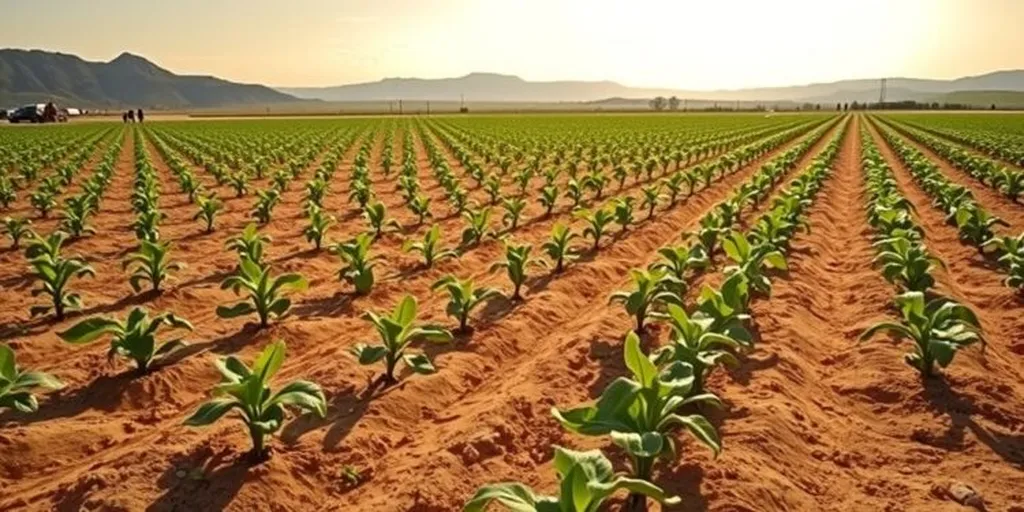
In the heart of Saudi Arabia’s Al-Ahsa region, a team of researchers led by Othman Al-Dossary from King Faisal University is pioneering a novel approach to crop management that could revolutionize how we tackle abiotic stress in agriculture. Their work, recently published in *Frontiers in Plant Science*, explores the use of nanotechnology to enhance plant resilience, offering a promising path towards more efficient and sustainable farming practices.
Abiotic stress—caused by non-living factors such as drought, salinity, and extreme temperatures—poses a significant threat to global crop yields. Traditional methods of mitigating these stresses often fall short, leaving farmers vulnerable to unpredictable climate conditions. Enter nanotechnology, a field that has already made waves in medicine and electronics, now poised to transform agriculture.
Al-Dossary and his team have been investigating how nanotechnology can be harnessed to improve plant signaling pathways, which are crucial for stress responses. “By leveraging nanotechnology, we can deliver targeted treatments that enhance a plant’s natural defenses,” Al-Dossary explains. “This precision allows us to use fewer resources while achieving better results, which is a game-changer for sustainable agriculture.”
The research delves into the use of nanoparticles to deliver bioactive compounds directly to plants, enhancing their ability to withstand environmental stressors. These nanoparticles can act as carriers, ensuring that the compounds are delivered efficiently and effectively. “The beauty of this approach lies in its specificity,” says Al-Dossary. “We can tailor the nanoparticles to target specific pathways, making the treatment more efficient and reducing the need for broad-spectrum interventions.”
The commercial implications of this research are substantial. As the global population continues to grow, the demand for food is expected to rise dramatically. Abiotic stress is a major limiting factor in crop productivity, and finding ways to mitigate its effects could significantly boost yields. “This technology has the potential to make farming more resilient and sustainable,” Al-Dossary notes. “It could help farmers produce more food with fewer resources, which is crucial for meeting the demands of a growing population.”
The research also highlights the importance of interdisciplinary collaboration. By bringing together experts from agriculture, biotechnology, and nanotechnology, the team has been able to develop innovative solutions that address real-world problems. “This is a great example of how different fields can come together to drive progress,” Al-Dossary says. “It’s not just about developing new technologies; it’s about applying them in ways that make a tangible difference.”
Looking ahead, the team is optimistic about the future of nanotechnology in agriculture. “We’re just scratching the surface of what’s possible,” Al-Dossary says. “As we continue to refine these techniques, we expect to see even more significant improvements in crop resilience and sustainability.”
The work published in *Frontiers in Plant Science* by Al-Dossary and his colleagues represents a significant step forward in the quest for more resilient and sustainable agriculture. By harnessing the power of nanotechnology, they are paving the way for a future where farmers can better withstand the challenges posed by a changing climate. As the world grapples with the realities of food security, this research offers a beacon of hope, demonstrating the potential of innovative solutions to address some of our most pressing challenges.