
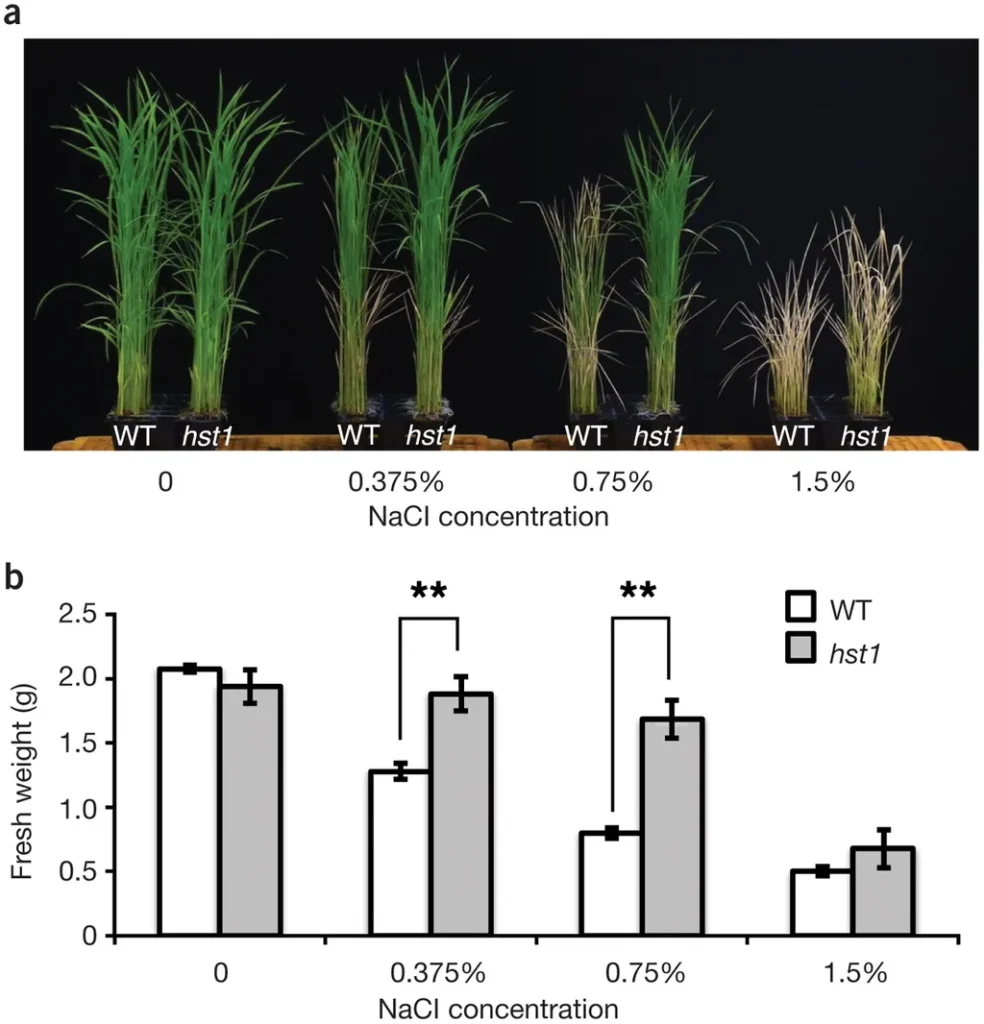
In the quest to enhance crop resilience, a recent study has shed light on the genetic underpinnings of salt tolerance in rice, offering promising avenues for breeders and farmers alike. Conducted by N. Pushparajan from the Department of Plant Molecular Biology and Biotechnology at Tamil Nadu Agricultural University, the research, published in the ‘International Journal of Bio-Resource and Stress Management’, employed association mapping using simple sequence repeat (SSR) markers to unravel the genetic diversity and marker-trait associations for salt tolerance in rice.
The study assessed genetic variability for salt tolerance among 172 rice accessions using two key physiological indices: shoot potassium concentration (SKC) and shoot sodium concentration (SNC). The findings revealed a wide range of variance for these indices, indicating substantial genetic diversity for salt tolerance within the studied germplasm. “This diversity is crucial as it provides a broad genetic base for breeders to develop salt-tolerant rice varieties,” Pushparajan explained.
To delve deeper, the researchers selected eight SSR markers near the SKC QTL (qSKC-1) locus on chromosome 1 and six SSR markers near the SNC QTL (qSNC-7) locus on chromosome 7. Using a set of 40 polymorphic SSR loci, they performed association mapping to identify marker-trait associations for the two physiological traits. The analysis identified four loci significantly associated with the qSKC-1 QTL and two loci associated with the qSNC-7 QTL, using both simple linear and multiple regression analyses.
The implications of this research are profound for the agriculture sector. “The marker loci identified in this study can be utilized for marker-assisted selection (MAS), map-based cloning of salt tolerance genes, and functional genomics studies,” Pushparajan noted. This could significantly accelerate the breeding process, enabling the development of rice varieties that can thrive in saline soils, which are increasingly prevalent due to climate change and poor water management practices.
Moreover, the study’s findings could have a substantial commercial impact. Rice is a staple food for more than half of the world’s population, and salt stress is a major constraint to rice production in many regions. By developing salt-tolerant rice varieties, farmers could improve yields and income, while also enhancing food security. Additionally, the insights gained from this research could extend beyond rice, potentially benefiting other crops facing similar challenges.
Looking ahead, this research paves the way for further exploration of the genetic mechanisms underlying salt tolerance. Future studies could focus on fine-mapping the identified QTLs, cloning the associated genes, and elucidating their functional roles. Furthermore, integrating these findings with other omics technologies, such as genomics, transcriptomics, and metabolomics, could provide a more comprehensive understanding of salt tolerance in rice.
In conclusion, this study represents a significant step forward in our understanding of salt tolerance in rice. By harnessing the power of association mapping and molecular markers, researchers have opened up new possibilities for enhancing crop resilience and securing our food supply in the face of a changing climate. As Pushparajan aptly put it, “This is not just about improving rice; it’s about securing our future.”