
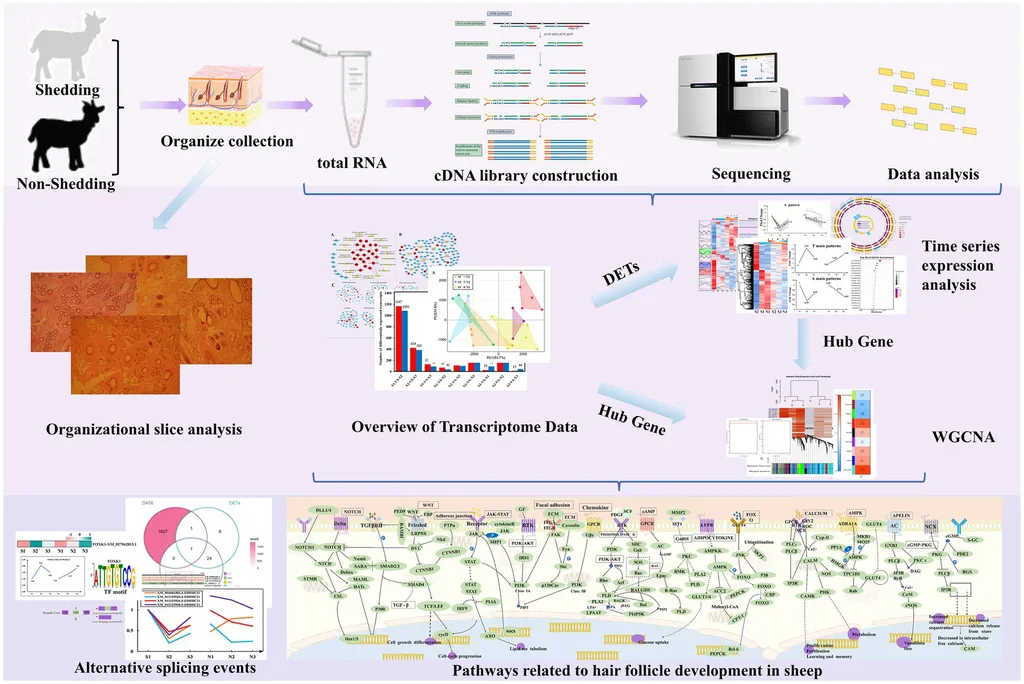
In a groundbreaking study published in *Frontiers in Veterinary Science*, researchers have unveiled key genes that influence hair follicle development in Qianhua Mutton Merino sheep, a breed prized for its wool quality. Led by Zhiyun Qin of the Key Laboratory of Evaluation and Utilization of Livestock and Poultry Resources at Jilin Agricultural University, the study offers a deeper understanding of the molecular mechanisms behind wool formation, potentially revolutionizing the agricultural sector.
The research team compared the morphological changes and gene expression profiles of hair follicles in newborn and one-year-old Qianhua Mutton Merino sheep. Using advanced transcriptome sequencing on the Illumina NovaSeq 6000 platform, they identified 1,637 differentially expressed genes (DEGs), with 1,134 upregulated and 503 downregulated. This comprehensive analysis highlighted several critical genes, including KRT27, IGF-2, FGF21, VEGF-D, KRT25, and KRT26, which play pivotal roles in hair follicle development.
“Our findings provide a theoretical basis for further revealing the molecular mechanisms underlying the formation of wool traits in Qianhua Mutton Merino sheep,” said Zhiyun Qin, the lead author of the study. The study’s results indicated that as the sheep aged, the density of both primary and secondary hair follicles decreased significantly, while the secondary-to-primary (S/P) ratio increased. This discovery could have profound implications for breeders aiming to optimize wool production.
The researchers also conducted GO and KEGG pathway enrichment analyses, revealing that the DEGs were enriched in signaling pathways associated with hair follicle development, such as the PI3K-Akt, MAPK, and Estrogen signaling pathways. These insights could pave the way for targeted genetic modifications to enhance wool quality and quantity.
The study’s findings were validated through real-time quantitative PCR and immunohistochemistry, ensuring the accuracy and reliability of the results. The KRT27 gene, for instance, was found to be significantly upregulated at 12 months of age, highlighting its crucial role in hair follicle development.
This research not only advances our understanding of the molecular mechanisms behind wool formation but also offers practical applications for the agricultural sector. By identifying key genes involved in hair follicle development, breeders and researchers can develop more effective strategies for improving wool traits in Qianhua Mutton Merino sheep. This could lead to increased productivity and economic benefits for the wool industry.
As Zhiyun Qin noted, “This study holds significant theoretical importance for revealing the molecular regulatory mechanism of hair follicle development in Qianhua Mutton Merino sheep.” The findings could also inspire further research into other wool-producing breeds, potentially leading to broader advancements in the field of animal genetics and agriculture.
In summary, this study represents a significant step forward in our understanding of hair follicle development in sheep. The identified genes and pathways provide a roadmap for future research and practical applications, ultimately benefiting the agricultural sector and the wool industry.