
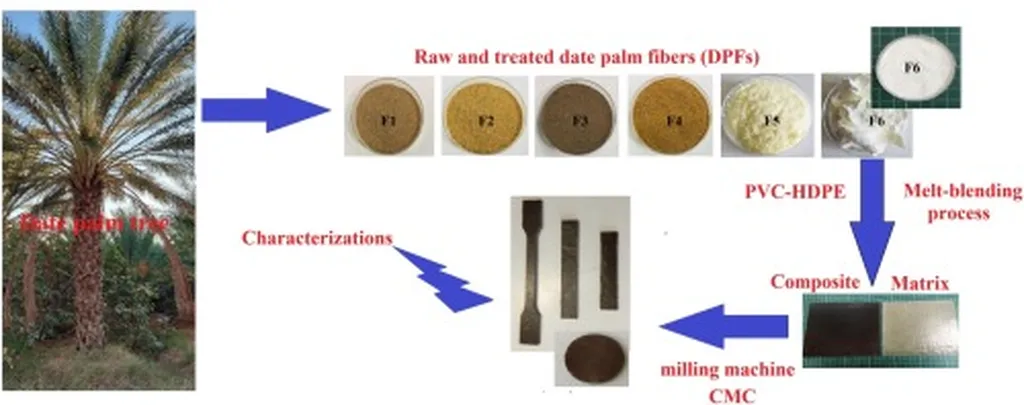
In the quest for sustainable and durable materials, researchers have turned to an unlikely combination: polyvinylchloride (PVC), date palm fibers (DPF), and copper filler (CF). A recent study published in the Iranian Journal of Chemistry & Chemical Engineering explores the potential of these materials to create biodegradable composite films with enhanced stability. The research, led by Abdeslam Boughezal from the Department of Industrial Chemistry at the University of Biskra in Algeria, offers promising insights into the future of biocomposites, particularly for the agriculture sector.
The study focuses on the preparation and characterization of PVC/DPF composite films, with and without the addition of copper filler. The films were exposed to natural weathering conditions, and their properties were analyzed using various techniques, including Fourier-Transform InfraRed (FT-IR) spectroscopy, UltraViolet-Visible (UV-Vis) spectroscopy, and X-Ray Diffraction (XRD). The results revealed that incorporating copper filler into the PVC/DPF composite significantly slowed the biodegradation rate, a finding that could have substantial implications for the agricultural industry.
“Incorporating copper filler into the PVC/DPF composite significantly slowed the biodegradation rate,” Boughezal explained. “This suggests that the material could be more durable and long-lasting, which is crucial for applications in agriculture where materials are often exposed to harsh environmental conditions.”
The study also investigated the water absorption and weight loss properties of the prepared materials. The results confirmed that the PVC/DPF/CF composite exhibited fewer structural defects and better stability compared to the PVC/DPF composite after exposure to natural weathering. This enhanced stability could make the material more suitable for use in agricultural applications, such as mulching films, irrigation systems, and protective coverings for crops.
The potential commercial impacts of this research are significant. The agriculture sector is constantly seeking innovative materials that are both sustainable and durable. The development of biocomposites that can withstand natural weathering conditions could lead to more efficient and environmentally friendly agricultural practices. Additionally, the use of date palm fibers, a renewable resource, aligns with the growing trend towards sustainability in the agriculture industry.
The research also highlights the importance of interdisciplinary collaboration in driving innovation. By combining expertise from chemistry, materials science, and agriculture, the study demonstrates the potential for creating novel materials that address real-world challenges. This approach could pave the way for future developments in the field of biocomposites, with applications extending beyond agriculture to other industries.
As the world continues to grapple with the challenges of sustainability and environmental degradation, the search for innovative solutions has never been more urgent. The research led by Boughezal offers a glimpse into the potential of biocomposites to address these challenges, providing a promising avenue for future exploration and development.