
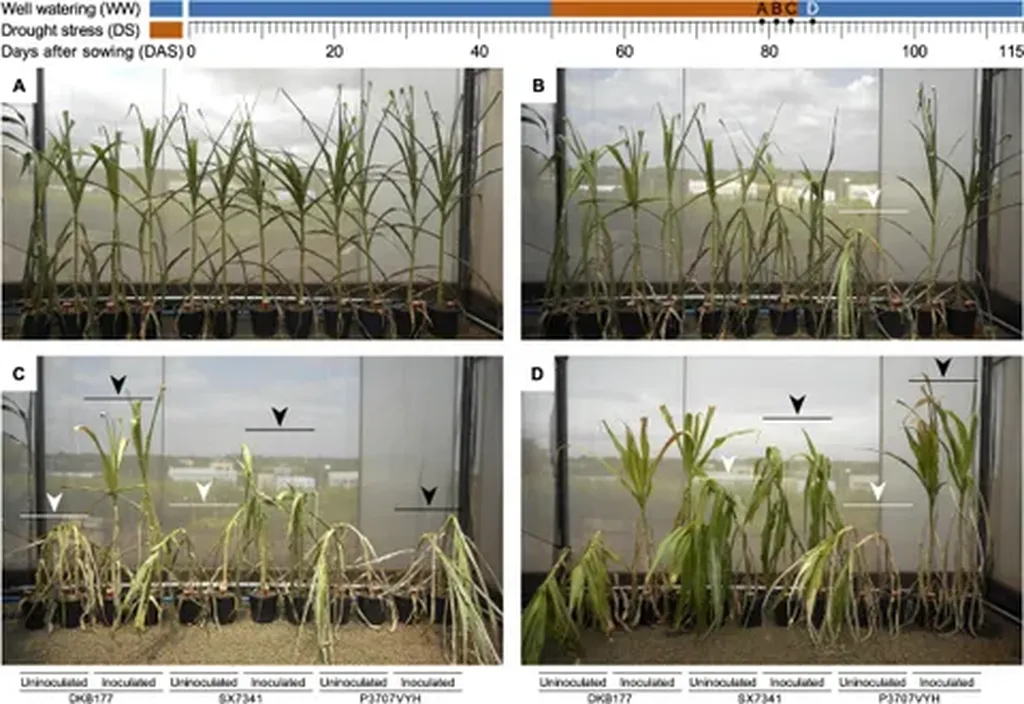
In the face of escalating climate challenges, farmers are increasingly seeking innovative solutions to safeguard their crops. A recent study published in *Scientific Reports* offers a promising strategy for enhancing drought tolerance in maize, a staple crop vital to global food security. Researchers led by Nermin G. Mohamed from the Department of Agricultural Biotechnology at Misr University of Science and Technology have demonstrated that seed biopriming with *Bacillus nematocida* can significantly bolster maize resilience under water-limited conditions.
The study, which involved treating maize seeds with *Bacillus nematocida* before subjecting them to drought stress in greenhouse conditions, revealed remarkable shifts in the expression of key stress-responsive genes. “We observed a substantial upregulation of genes associated with ABA signaling, ion homeostasis, and oxidative stress reduction,” Mohamed explained. Notably, genes such as *PLD* and *PYL1* showed a 60-fold and 63-fold increase in expression, respectively, under combined drought and biopriming conditions. This suggests that the treatment primes the plants to respond more effectively to drought stress.
The commercial implications of this research are substantial. Maize is a cornerstone of global agriculture, and drought stress poses a significant threat to yields and economic stability. By adopting seed biopriming techniques, farmers could potentially reduce crop losses and improve productivity in arid and semi-arid regions. “This approach not only enhances drought tolerance but also aligns with sustainable agricultural practices, reducing the need for chemical interventions,” Mohamed added.
The study’s findings highlight the potential of microbial-based solutions in modern agriculture. As climate change continues to exacerbate water scarcity, innovative strategies like biopriming could become integral to crop management. “The future of agriculture lies in integrating biotechnology with traditional farming practices,” Mohamed noted. “This research is a step towards that future, offering a scalable and environmentally friendly solution.”
The research also opens avenues for further exploration. Understanding the precise mechanisms by which *Bacillus nematocida* influences gene expression could lead to the development of more targeted and effective biopriming treatments. Additionally, the potential to extend these techniques to other crops could revolutionize agricultural practices worldwide.
In conclusion, this study underscores the importance of leveraging microbial interactions to enhance crop resilience. As the agricultural sector grapples with the challenges of climate change, solutions like seed biopriming with *Bacillus nematocida* offer a beacon of hope. By embracing these innovations, farmers can secure their livelihoods and contribute to global food security.