
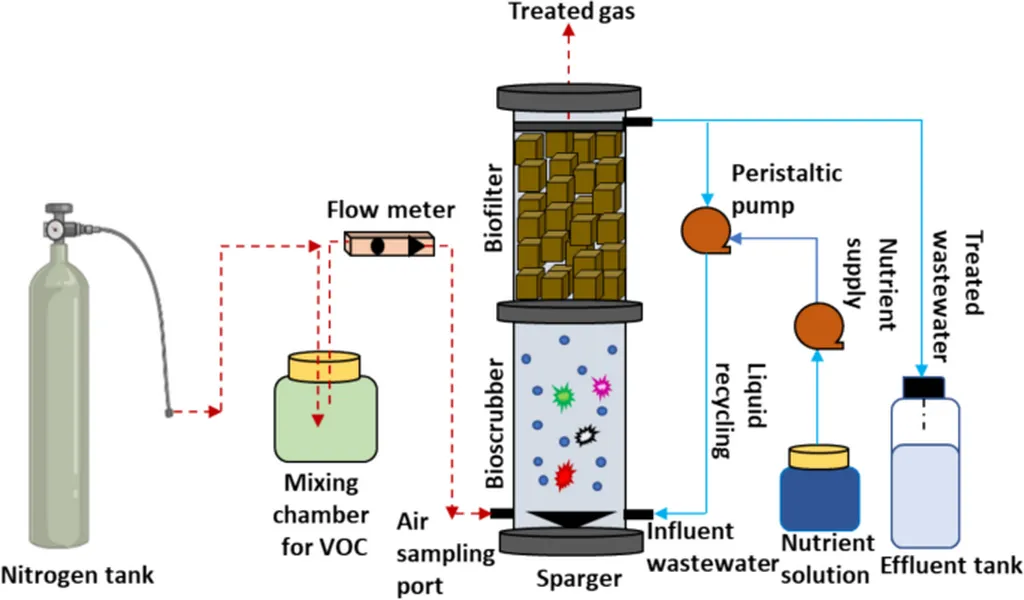
In the quest to mitigate environmental pollution and enhance sustainable practices, a team of researchers has made a significant stride in the biodegradation of volatile organic compounds (VOCs) using an innovative approach. The study, led by Hamed Nayyeri from the Department of Chemical Engineering at Arak Branch, Islamic Azad University, focuses on the biodegradation of Benzene, Toluene, and Xylene (BTX) using Airlift Parallel Bioreactors (APB’s) connected to a Plexiglas Bio-Scrubber (PBS) modulated with Polyurethane Foam (MPF). This research, published in the Iranian Journal of Chemistry & Chemical Engineering, holds promising implications for the agriculture sector and beyond.
The research team employed a microbial consortium derived from refinery Sludge Effluent Sewer (SES) treatment, coupled with a nutrient solution, to degrade BTX compounds. The bioreactors were filled with Activated Sludge Effluent Sewer (ASES) and tested at varying inlet BTX concentrations and air pollution flow rates. The results were striking. At an inlet pollutant concentration of 180.7 ppmv for benzene, 327.4 ppmv for toluene, and 297.5 ppmv for xylene, the removal efficiency at a flow rate of 2.5 lit/min was 90.7%, 88%, and 83.6% respectively. These findings underscore the potential of this method to effectively remove VOCs from polluted air streams.
“The use of mineral pumice as a porous filler, combined with the microbial consortium, proved to be a game-changer in enhancing the biodegradation process,” noted Nayyeri. This approach not only improves the efficiency of BTX removal but also offers a cost-effective and sustainable solution for environmental remediation.
The implications for the agriculture sector are profound. VOCs are common pollutants in agricultural settings, often resulting from the use of pesticides, fertilizers, and other chemicals. The ability to efficiently degrade these compounds can significantly reduce environmental impact and improve air quality in agricultural areas. Moreover, the use of wastewater sludge as a microbial source aligns with the principles of circular economy, turning waste into a valuable resource.
This research opens up new avenues for future developments in biotechnological applications. The integration of bio-scrubbers with advanced bioreactor systems can be explored for the treatment of various pollutants beyond BTX. Additionally, the optimization of operational parameters and the exploration of different microbial consortia can further enhance the efficiency and applicability of this technology.
As the world grapples with the challenges of environmental pollution and sustainable resource management, innovations like the one presented by Nayyeri and his team offer hope and a path forward. By leveraging the power of microbial consortia and advanced bioreactor systems, we can strive towards a cleaner, healthier, and more sustainable future.