
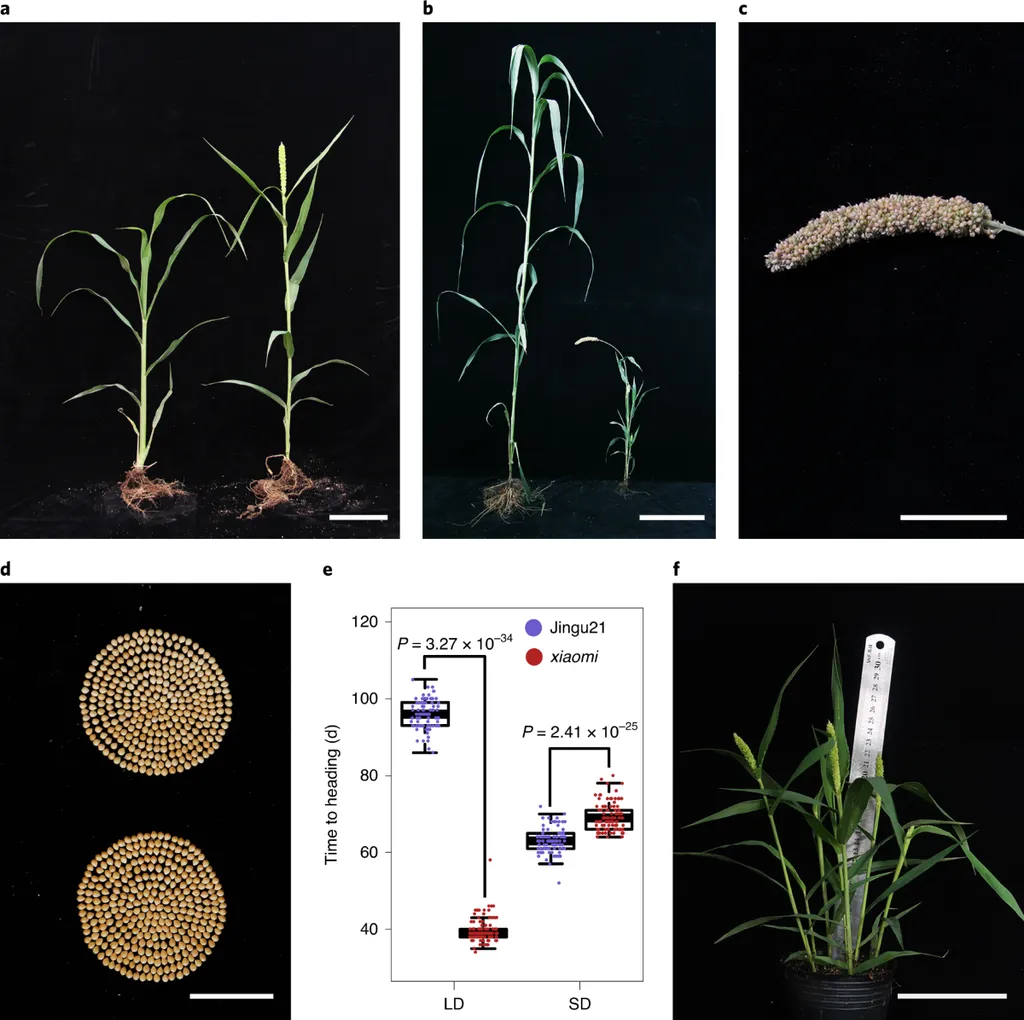
In the heart of China, researchers have uncovered a genetic secret that could revolutionize how we understand and cultivate crops under stress. Dan Zhu, a scientist at Yellow River Conservancy Technical Institute in Kaifeng, and his team have identified a family of genes in foxtail millet that play a pivotal role in the plant’s response to salt stress. Their findings, published in *Frontiers in Plant Science*, could have significant implications for agriculture, particularly in regions where soil salinity is a growing concern.
Foxtail millet, a crop known for its high photosynthetic efficiency and resilience to drought and salinity, has long been a subject of interest for plant scientists. Zhu and his team focused on the phosphoinositide-specific phospholipase C (PI-PLC) gene family, which is known to play a crucial role in lipid- and calcium-dependent signaling pathways in plants. “We identified five PI-PLC-encoding genes in foxtail millet, named SiPLC1 to SiPLC5,” Zhu explained. “Among these, SiPLC1 stood out due to its unique structure and high homology to similar genes in Arabidopsis and rice.”
The team’s analysis revealed that SiPLC1 is predominantly expressed in the roots during early stem elongation and is significantly upregulated under salt stress. To test the gene’s function, the researchers overexpressed SiPLC1 in Arabidopsis, a model plant often used in genetic studies. The results were promising: the Arabidopsis plants showed enhanced tolerance to salt stress, indicating that SiPLC1 plays a critical role in the plant’s stress response.
The implications of this research for the agriculture sector are substantial. As soil salinity affects an estimated 20% of irrigated lands worldwide, crops that can tolerate these conditions are in high demand. “Understanding the genetic basis of salt tolerance in foxtail millet could help us develop new varieties of crops that are more resilient to saline soils,” Zhu said. This could lead to increased yields and improved food security in regions where salinity is a major constraint.
Moreover, the study’s findings could pave the way for further research into the role of PI-PLC genes in other crops. “Our work provides a foundation for future studies on the function of PI-PLC genes in plant stress responses,” Zhu noted. This could lead to the development of new breeding techniques or genetic modifications that enhance crop resilience to a range of abiotic stresses.
The research also highlights the potential of foxtail millet as a model organism for studying the integration of yield and stress resilience. With its high photosynthetic efficiency and extensive stress tolerance, this crop offers a unique opportunity to understand how plants balance growth and defense under challenging conditions.
As the global population continues to grow and climate change exacerbates environmental stresses, the need for resilient crops has never been greater. The work of Zhu and his team offers a glimpse into the future of agriculture, where genetic insights could help us cultivate crops that are not only more productive but also more resilient to the challenges posed by a changing climate.