
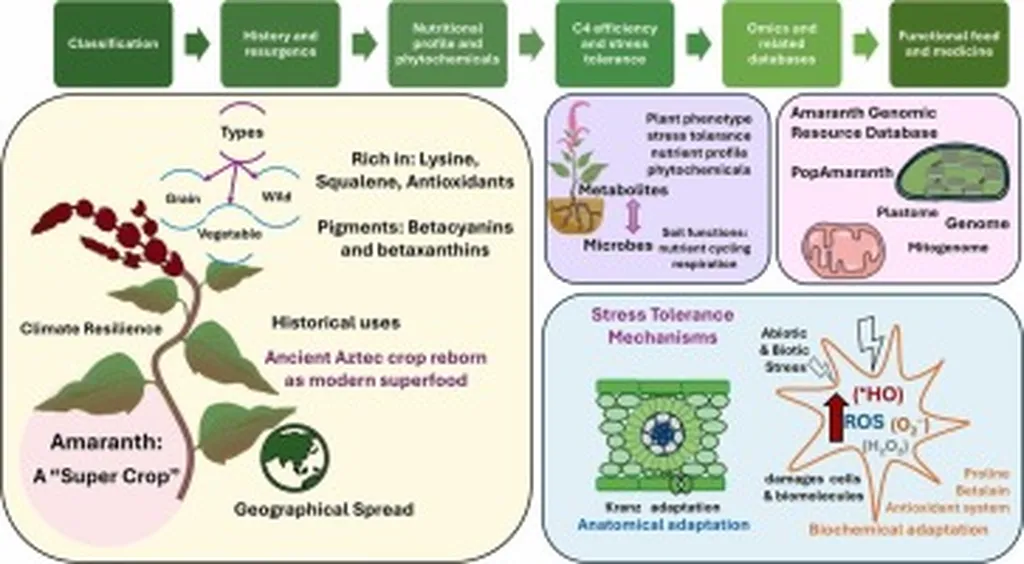
In the quest to improve crop resilience and yield, scientists have turned their attention to the humble grain amaranth, a nutrient-rich pseudocereal that has been a staple in many cultures for centuries. A recent study published in the *Hayati Journal of Biosciences* has shed light on the role of the Small Auxin-Up RNA (SAUR) gene family in grain amaranth, offering promising insights for the agriculture sector.
The research, led by Xuan Duong Vu from the Faculty of Natural Sciences at Hung Vuong University in Vietnam, identified and characterized 80 SAUR genes in grain amaranth. These genes are known to play a crucial role in plant growth and environmental adaptation. “SAUR genes are early auxin-responsive genes that regulate plant cell elongation, tissue differentiation, and adaptation to environmental stresses,” Vu explained. “Understanding these genes can help us enhance the agronomic traits of grain amaranth, making it more resilient to drought and other stresses.”
The study revealed that most SAUR genes in grain amaranth encode small, basic, and hydrophilic proteins, and the majority are intronless. Phylogenetic analysis grouped the amaranth SAURs into ten clades alongside those from Arabidopsis, a widely studied model plant. This classification helps in understanding the evolutionary relationships and potential functions of these genes.
One of the most significant findings was the tissue-preferential expression of several SAUR genes, including AhSAUR76, AhSAUR71, AhSAUR65, AhSAUR54, and AhSAUR73. These genes showed high expression levels in specific tissues and responsiveness to drought stress. “This suggests that these genes could be key players in the plant’s adaptation to drought, a critical factor in agriculture,” Vu noted.
The commercial implications of this research are substantial. Drought stress is a major challenge for farmers worldwide, and crops that can withstand such conditions are highly sought after. By identifying and characterizing these SAUR genes, researchers have opened the door to potential genetic modifications that could enhance drought resistance in grain amaranth and possibly other crops.
Moreover, grain amaranth is already valued for its high nutritional content, including high levels of protein, fiber, and essential vitamins and minerals. Improving its resilience could make it an even more attractive crop for farmers and consumers alike. “This research provides a valuable resource for future genetic and functional studies aimed at enhancing agronomic traits in grain amaranth,” Vu added.
The study not only highlights the potential of grain amaranth as a resilient crop but also underscores the importance of understanding the genetic basis of plant adaptation. As climate change continues to pose challenges to agriculture, such research becomes increasingly vital. The findings could pave the way for developing more resilient crop varieties, ultimately contributing to food security and sustainable agriculture.
In the broader context, this research is a testament to the power of modern genetic techniques in unraveling the complexities of plant biology. It offers a glimpse into the future of agriculture, where genetic insights could drive the development of crops that are not only high-yielding but also resilient to the ever-changing environmental conditions. As the agriculture sector continues to evolve, such studies will be instrumental in shaping the future of farming and food production.