
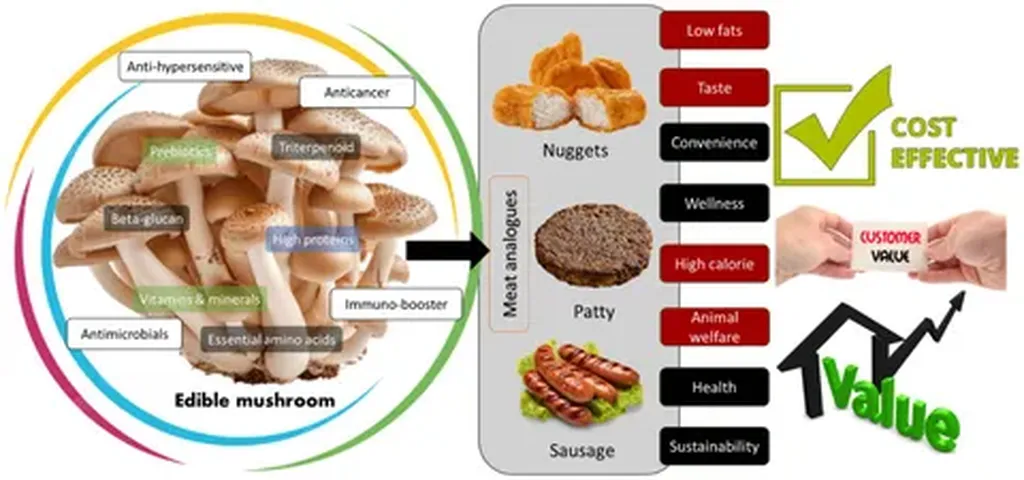
In the quest to enhance food quality and safety, researchers have turned to an unlikely ally: mushrooms. A recent study published in *Current Research in Food Science* reveals that exosome-like nanoparticles derived from edible mushrooms could revolutionize the way we preserve and process meat products, particularly chicken sausages. The findings, led by Yucheng He from the College of Food Science and Technology at Hunan Agricultural University, highlight a promising new avenue for the agritech industry.
Mushroom exosome-like nanoparticles (M-ELNs), particularly those from the Flammulina velutipes species, have been found to possess potent antioxidant properties. These nanoparticles, rich in phenolic compounds, can significantly suppress lipid and protein oxidation during refrigerated storage. This not only reduces drip loss but also mitigates texture deterioration, ensuring that chicken sausages remain fresh and appealing for longer periods.
One of the most striking aspects of this research is the ability of M-ELNs to inhibit the formation of advanced glycation end products (AGEs) after thermal processing. AGEs are harmful compounds that form when proteins and fats react with sugars, a process accelerated by high temperatures. “Our mechanistic studies demonstrated that M-ELNs function through a dual pathway: scavenging free radicals and depleting residual nitrite,” explains He. This dual action not only enhances the safety of meat products but also improves their nutritional profile.
The commercial implications of this research are substantial. For the agriculture sector, the adoption of M-ELNs as a natural additive could lead to the development of healthier and higher-quality meat products. This innovation aligns with the growing consumer demand for clean-label, minimally processed foods. By incorporating M-ELNs into their products, food manufacturers can offer consumers a safer and more nutritious option without compromising on taste or texture.
Moreover, the use of mushroom-derived exosomes could reduce the reliance on synthetic additives, which have long been a point of contention among health-conscious consumers. This shift towards natural additives could open up new markets and drive innovation within the agritech industry.
The study’s findings also pave the way for further research into the potential applications of mushroom exosomes in other food products. As He notes, “The versatility of M-ELNs suggests that they could be used in a wide range of food products beyond chicken sausages.” This could include meats, dairy products, and even plant-based alternatives, offering a broad spectrum of opportunities for food scientists and manufacturers.
In conclusion, the research led by Yucheng He represents a significant step forward in the quest for safer and more nutritious food products. By harnessing the power of mushroom exosomes, the agritech industry can meet the evolving demands of consumers while driving innovation and growth. As the food industry continues to evolve, the integration of natural additives like M-ELNs could become a cornerstone of sustainable and health-conscious food production.