
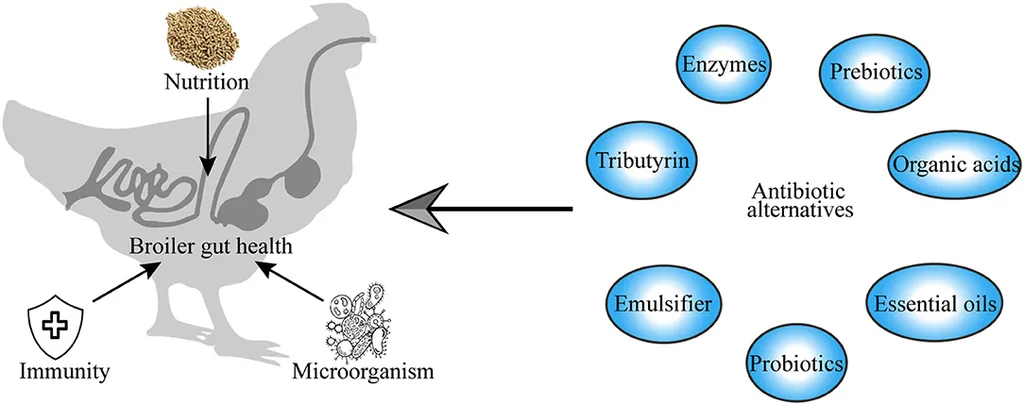
In the quest to enhance broiler growth and intestinal health, researchers have turned to an unlikely ally: Bacillus subtilis peptide. A recent study published in the *Italian Journal of Animal Science* has shed light on the potential benefits of supplementing broiler diets with this peptide, offering promising insights for the agriculture sector.
The study, led by Mengli Zheng from the State Key Laboratory of Animal Nutrition at the Chinese Academy of Agricultural Sciences, involved 240 one-day-old male broilers divided into four groups. Over a 42-day period, the researchers observed significant improvements in growth performance, intestinal barrier function, and caecal microbiota metabolism in broilers fed diets supplemented with B. subtilis peptide.
One of the most notable findings was the increase in average feed intake among broilers in the low-dose B. subtilis peptide group. “We observed a significant increase in feed intake from day one to day 42 in the low-dose group compared to the control group,” Zheng noted. This finding is particularly relevant for commercial broiler production, where efficient feed conversion is crucial for profitability.
The study also revealed that low-dose B. subtilis peptide supplementation improved average daily gain and reduced the feed-to-weight ratio during the 22 to 42-day period. This suggests that B. subtilis peptide could be a valuable tool for optimizing broiler growth performance.
In terms of intestinal health, the high-dose B. subtilis peptide group showed upregulated levels of Claudin-1 and Occludin-1 mRNA in the ileum and jejunum. These proteins are essential for maintaining the integrity of the intestinal barrier, which is vital for preventing pathogens and toxins from entering the bloodstream.
The researchers also found that all doses of B. subtilis peptide elevated the concentrations of various short-chain fatty acids in the caecum, including acetic, propionic, butyric, valeric, and 2-methylbutyric acid. These fatty acids play a crucial role in maintaining gut health and function.
At the phylum level, low-dose B. subtilis peptide treatment significantly increased the abundance of Cyanobacteria. At the genus level, all B. subtilis peptide treatments reduced the abundance of Bacteroides in broiler caecal contents. High-dose B. subtilis peptide also significantly decreased caecal Lactobacillus abundance.
These findings suggest that B. subtilis peptide supplementation could help modulate the metabolism of intestinal flora, potentially leading to improved gut health and overall broiler performance.
The commercial implications of this research are substantial. As the global demand for poultry meat continues to rise, farmers are constantly seeking ways to improve growth rates and feed efficiency. B. subtilis peptide supplementation offers a promising avenue for achieving these goals, potentially leading to increased profitability for broiler producers.
Moreover, the findings could pave the way for further research into the use of probiotics and peptides in animal nutrition. As Zheng points out, “Our study provides a foundation for future research into the mechanisms underlying the effects of B. subtilis peptide on broiler growth and intestinal health.”
In conclusion, this study highlights the potential of B. subtilis peptide as a feed additive for broilers. By improving growth performance, intestinal barrier function, and microbiota metabolism, this peptide could offer significant benefits for the agriculture sector. As researchers continue to explore the complexities of gut health and nutrition, B. subtilis peptide may well emerge as a key player in the quest for sustainable and efficient broiler production.