
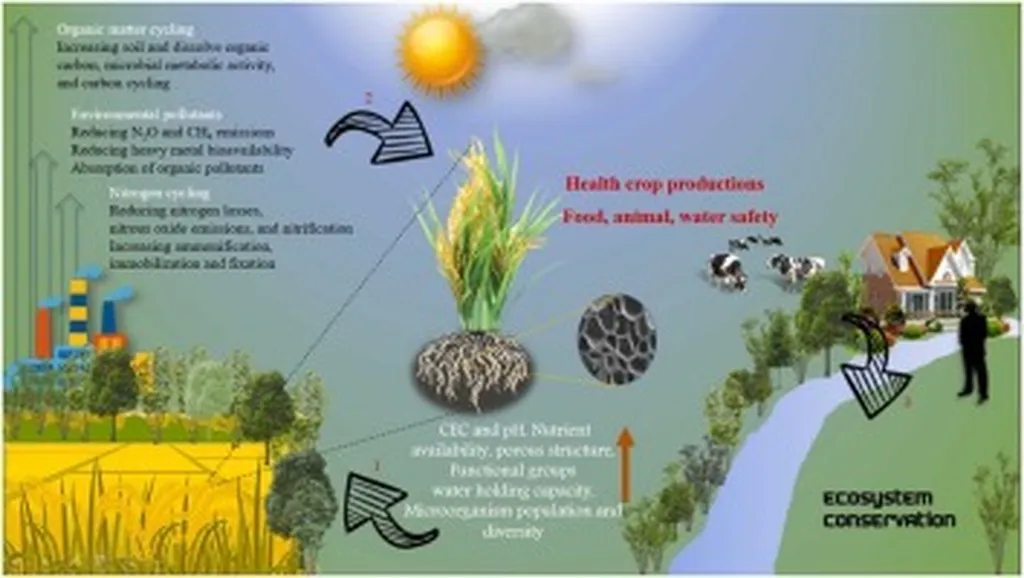
In the heart of India’s sub-humid tropics, a groundbreaking study is reshaping our understanding of rice cultivation, offering a beacon of hope for farmers grappling with water scarcity. The research, led by Peeyush Sharma from the Division of Soil Science and Agricultural Chemistry at Sher-e-Kashmir University of Agricultural Sciences and Technology of Jammu, explores the synergistic effects of biochar and anionic polyacrylamide (PAM) on soil health, water conservation, and rice productivity.
The study, published in *Frontiers in Plant Science*, reveals that the combination of biochar and PAM, when integrated with the System of Rice Intensification (SRI), can significantly enhance soil hydraulic properties, root development, and water productivity. This is a game-changer for an industry where efficient water use is becoming increasingly critical.
“Our findings demonstrate that SRI, when combined with biochar and PAM, can produce higher yields while using less water,” Sharma explains. “This is a significant step towards sustainable rice cultivation, especially in regions facing water shortages.”
The two-year field experiment conducted on sandy clay loam soil showed that SRI produced 15% higher grain yield while using 28.2% less irrigation water compared to conventional methods. The application of biochar (10 t ha⁻¹) and PAM (10 kg ha⁻¹) further enhanced soil physical attributes, resulting in a 22% increase in grain yield and a 27% increase in root length density.
The commercial implications of this research are profound. As water resources decline and the global population grows, the agricultural sector is under immense pressure to produce more with less. This study offers a viable solution, demonstrating that by enhancing soil health and water retention, farmers can achieve higher yields without compromising their most precious resource—water.
The integration of biochar and PAM with SRI not only improves soil moisture content and infiltration rate but also boosts water productivity by 46.5%. This means farmers can achieve more with less, a critical factor in the face of climate change and water scarcity.
As we look to the future, this research paves the way for more sustainable and efficient agricultural practices. By adopting these innovative techniques, the agriculture sector can mitigate the impacts of water scarcity, enhance productivity, and contribute to global food security. The study’s findings are a testament to the power of scientific innovation in driving agricultural progress, offering hope for a more sustainable and food-secure future.
The research, led by Peeyush Sharma and published in *Frontiers in Plant Science*, underscores the potential of biochar and PAM in revolutionizing rice cultivation. As the agricultural sector continues to evolve, these findings will undoubtedly shape future developments, guiding farmers and researchers towards more sustainable and productive practices.