
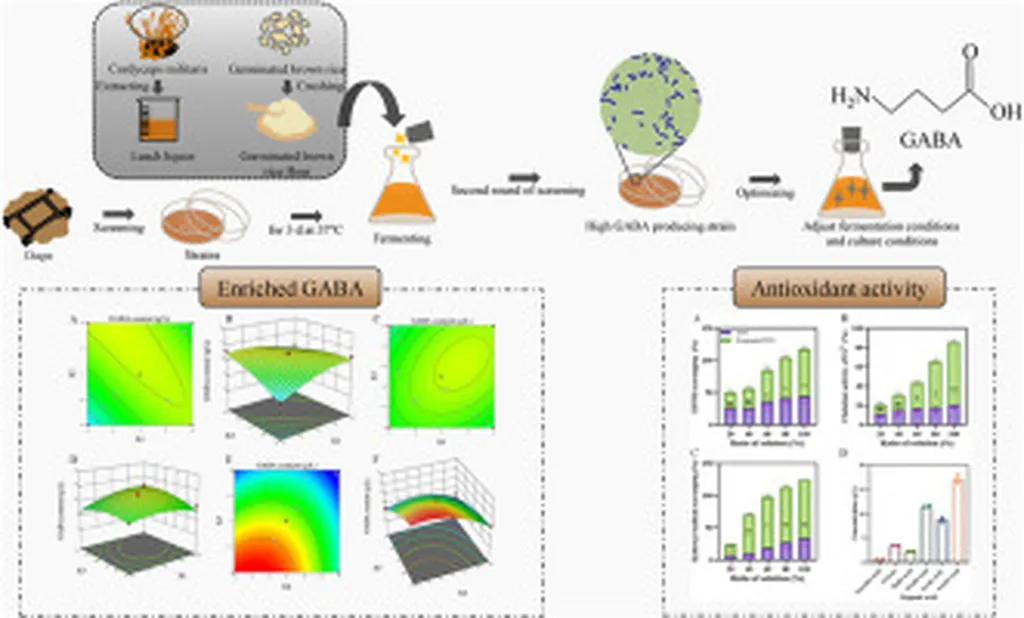
In the ever-evolving landscape of functional foods and beverages, a recent study published in *Current Research in Food Science* has uncovered a promising avenue for enhancing the nutritional profile of everyday drinks. Researchers, led by Kaihui Shen from the Jiangsu Key Laboratory of Sericultural and Animal Biotechnology at Jiangsu University of Science and Technology, have identified a probiotic strain, Levilactobacillus brevis GH1, derived from Daqu, the fermentation starter used in the production of baijiu, a traditional Chinese liquor. This strain has shown remarkable potential in boosting the concentration of γ-aminobutyric acid (GABA) and antioxidant properties in beverages made from Cordyceps militaris fruiting body extracts and germinated brown rice.
GABA is a functional amino acid known for its various physiological benefits, including its role in reducing stress and promoting relaxation. The study highlights the potential of leveraging traditional fermentation techniques to create modern, health-enhancing beverages. “The use of Daqu as a screening resource for functional lactic acid bacteria opens up new possibilities for the food and beverage industry,” Shen explains. “This research not only enhances our understanding of the probiotic properties of Levilactobacillus brevis GH1 but also demonstrates its potential in developing functional foods with elevated GABA content.”
The study found that under optimal fermentation conditions—30.83 g/L sucrose, 1.04 g/L corn steep liquor powder, and 52.74% Cordyceps militaris fruiting body extraction solution at pH 4.06 and a culture temperature of 34.40°C—the GABA concentration reached an impressive 16.83 g/L. Additionally, the beverage exhibited significant increases in antioxidant activities, with DPPH scavenging ability, Fe2+ chelating ability, and hydroxyl free radical scavenging ability increasing by 1.7, 3.2, and 2.7 times, respectively. The beverage was also found to be rich in various organic acids, including lactic acid, acetic acid, oxalic acid, succinic acid, citric acid, and malic acid.
The implications of this research for the agriculture sector are substantial. The ability to enhance the nutritional profile of beverages through fermentation processes can drive demand for ingredients like Cordyceps militaris and germinated brown rice, potentially boosting the market for these crops. “This study underscores the importance of integrating traditional knowledge with modern biotechnology to create innovative food products,” Shen adds. “It also highlights the potential for probiotics to play a crucial role in the development of functional foods.”
As the global market for functional foods and beverages continues to grow, the findings of this study could pave the way for new product developments and commercial opportunities. The use of probiotics like Levilactobacillus brevis GH1 not only enhances the nutritional value of beverages but also aligns with consumer preferences for natural and health-promoting ingredients. This research, published in *Current Research in Food Science* and led by Kaihui Shen from the Jiangsu Key Laboratory of Sericultural and Animal Biotechnology, offers a glimpse into the future of functional beverages and the role that traditional fermentation techniques can play in shaping the agriculture sector.