
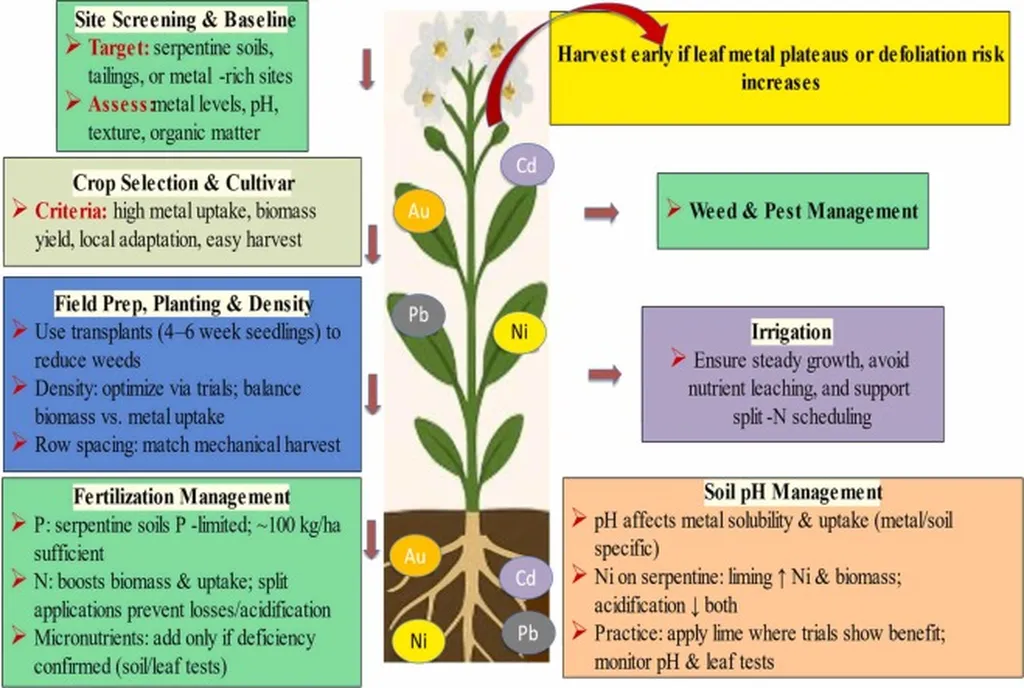
In a groundbreaking review published in *Industrial Crops and Products*, researchers have highlighted the potential of hyperaccumulator plants as a dual-purpose industrial crop, offering a sustainable solution for metal recovery and biomass utilization on marginal lands. This innovative approach could revolutionize the agriculture sector by transforming unproductive or contaminated land into valuable resources.
Hyperaccumulator plants are specialized species that can tolerate and accumulate exceptionally high concentrations of metals such as nickel, cobalt, thallium, and even gold. These plants not only extract valuable metals from the soil but also produce biomass that can be used for energy and materials. This dual-purpose strategy, known as phytomining, presents a promising avenue for sustainable crop production.
The review, led by Yingdui He from the Institute of Tropical Bioscience and Biotechnology at the Chinese Academy of Tropical Agricultural Sciences, examines the agronomic, physiological, and economic dimensions of using hyperaccumulators as industrial crops. Key species such as Alyssum corsicum and Streptanthus polygaloides for nickel, Haumaniastrum spp. for cobalt, and Iberis intermedia for thallium have shown remarkable potential. These plants produce metal-rich, low-sulfur biomass, or “bio-ore,” which can significantly reduce downstream processing costs and energy demands.
One of the most exciting findings is the potential for gold phytomining. For instance, Daucus carota L., commonly known as carrot, can produce up to 16 tons of biomass per hectare with a gold content of 48.3 mg/kg. Under current market values, this could yield up to $85,690 per hectare, making it an economically viable option for farmers.
“The economic viability of these crops depends on multiple factors, including biomass yield, metal content, site conditions, and global metal prices,” explains He. “However, the potential is immense, especially in tropical regions where year-round growth is possible.”
The combustion of harvested biomass not only provides energy but also concentrates metals in the ash, enabling storage and delayed metal extraction. This flexibility is particularly advantageous under volatile market conditions, allowing farmers to optimize their returns.
The integration of hyperaccumulators into sustainable land management practices supports circular economy goals by combining metal recovery, energy production, and environmental restoration. This approach could transform marginal lands into productive systems, contributing to the development of low-input, metal-yielding biomass systems.
As the agriculture sector seeks innovative solutions to enhance productivity and sustainability, the use of hyperaccumulators as industrial crops offers a promising path forward. This research not only highlights the potential economic benefits but also underscores the importance of further agronomic optimization and commercialization.
With the growing demand for sustainable and efficient agricultural practices, the findings from this review could shape future developments in the field, paving the way for a more resilient and resource-efficient agriculture sector.