
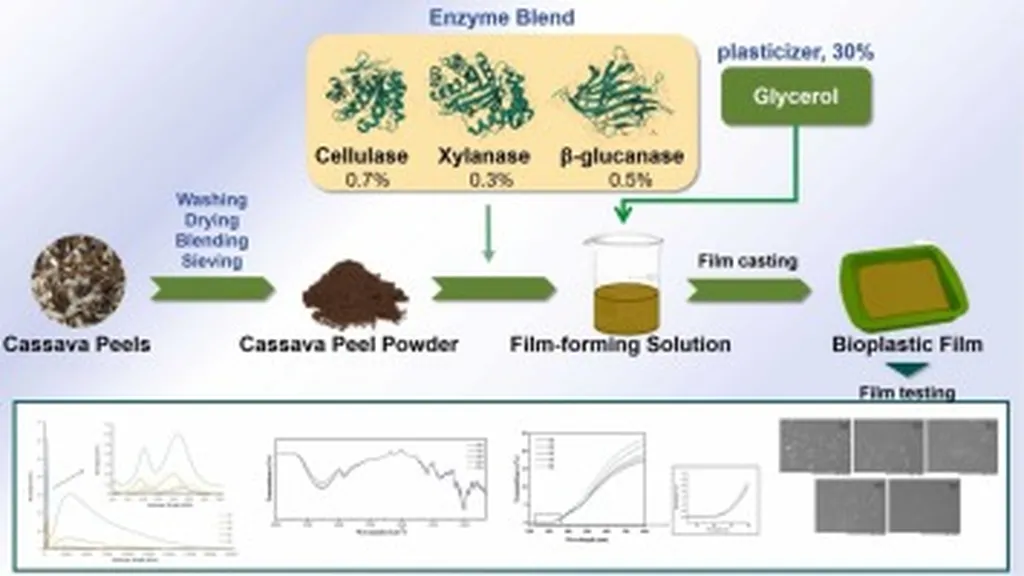
In the heart of Thailand, researchers are turning agricultural waste into valuable resources, offering a promising solution to both energy and environmental challenges. A recent study published in *Industrial Crops and Products* demonstrates how cassava pulp, a byproduct of the cassava starch industry, can be transformed into biohydrogen and bioplastics, potentially revolutionizing the agricultural sector.
Cassava pulp, a readily available and low-cost feedstock, is rich in carbohydrates, making it an ideal candidate for biohydrogen production. The research team, led by Ayyapruk Moungprayoon from the Department of Biotechnology at Khon Kaen University, employed a high-solids simultaneous saccharification and dark fermentation (SSDF) process to maximize biohydrogen yield. “The high-solids SSDF process is a significant advancement,” Moungprayoon explains. “It allows us to process a higher concentration of cassava pulp, resulting in a more efficient and cost-effective production of biohydrogen.”
The process yielded an impressive 3168 mL of biohydrogen, with a yield of 21.1 mL-H2/g-CP. The hydrogenic effluent, rich in lactic acid, acetic acid, and butyric acid, was then used to produce poly(3-hydroxybutyrate) (PHB), a bioplastic recognized as a viable alternative to synthetic plastics. “The sequential process of high-solids SSDF and fed-batch fermentation is a game-changer,” says Moungprayoon. “It not only addresses the energy challenge but also contributes to waste valorization and environmental sustainability.”
The commercial impacts of this research are substantial. The agricultural sector, particularly the cassava starch industry, stands to benefit significantly from this innovative approach to waste management. By converting cassava pulp into valuable biohydrogen and bioplastics, farmers and processors can reduce waste disposal costs and generate additional revenue streams. Moreover, the production of bioplastics offers a sustainable alternative to synthetic plastics, addressing the growing environmental concerns associated with plastic waste.
The research also opens up new avenues for future developments in the field of bioenergy and bioplastics. The high-solids SSDF process and the sequential production of biohydrogen and bioplastics present a novel approach to waste valorization, paving the way for similar applications in other agricultural sectors. As Moungprayoon notes, “This study is just the beginning. The potential for scaling up and optimizing the process is enormous, and we are excited about the possibilities it holds for the future.”
In conclusion, this groundbreaking research highlights the potential of agricultural waste as a valuable resource for bioenergy and bioplastics. The innovative approach demonstrated by Moungprayoon and his team offers a sustainable solution to the energy and environmental challenges faced by the agricultural sector, paving the way for a more sustainable and profitable future.