
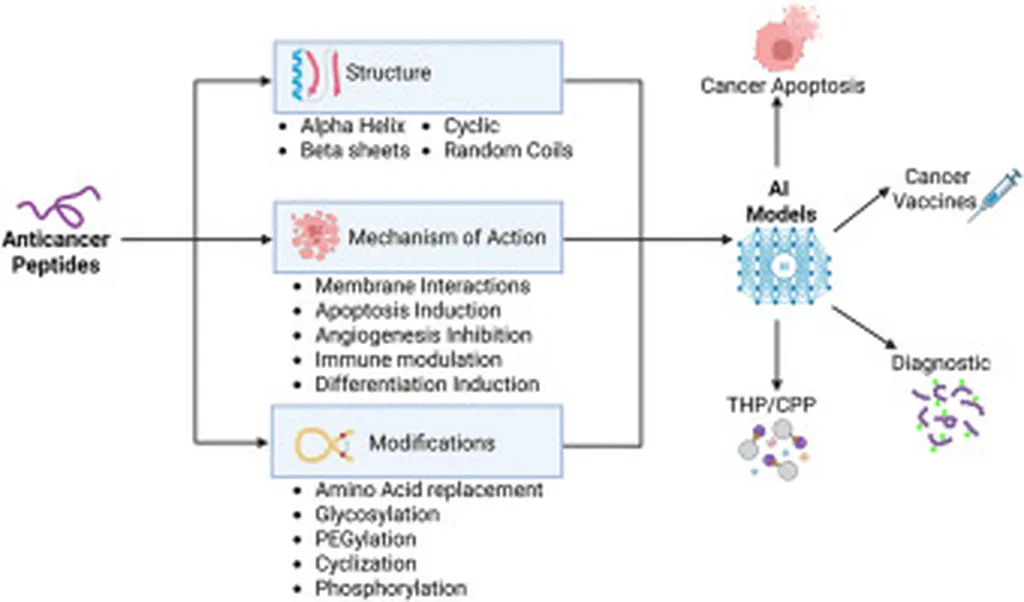
In the relentless battle against cancer, researchers are turning to an unlikely ally: artificial intelligence. A recent study published in *iMetaOmics* has unveiled a promising approach to discovering anticancer peptides (ACPs) using AI, potentially revolutionizing the way we develop cancer treatments and even impacting the agriculture sector.
Cancer remains a formidable global health challenge, with current therapies often falling short due to limitations like toxicity and lack of specificity. ACPs, however, offer a beacon of hope. These small proteins are highly selective, targeting cancer cells while sparing healthy ones, and boast low toxicity and multitarget effects. “ACPs have gradually become a research focus in the development of novel peptide-based anticancer drugs,” says Junrui Wu, lead author of the study and a researcher at the College of Food Science, Shenyang Agricultural University.
The traditional methods of screening ACPs, however, are akin to finding a needle in a haystack. They are time-consuming, costly, and technically complex, making them ill-suited for high-throughput applications. Enter artificial intelligence. Machine learning and deep learning algorithms have significantly improved the efficiency and accuracy of ACP screening, offering a glimmer of hope in the fight against cancer.
The study systematically summarizes the advantages and limitations of 68 AI models used for ACP screening. While these models show considerable potential, most lack interpretability and wet-laboratory validation, which are crucial for their credibility and practical effectiveness.
To address these challenges, the researchers presented a comprehensive ACP screening framework based on AI models. This framework includes data collection and organization, feature extraction, model construction, model interpretability analysis, and experimental validation. The researchers also integrated this screening framework with multi-omics and other biotechnologies to promote the translation of AI-selected ACPs to the clinic.
The implications of this research extend beyond the realm of medicine. In the agriculture sector, the development of ACPs could lead to innovative pest management strategies. By targeting specific pests, these peptides could reduce the need for broad-spectrum pesticides, promoting more sustainable and environmentally friendly farming practices.
The study’s findings could also pave the way for the development of new AI-driven tools for drug discovery and development. As Wu explains, “The presented AI-based ACP screening framework can accelerate the ACP development, increase ACP screening efficiency, and promote clinical ACP application.”
In the ever-evolving landscape of cancer research, this study marks a significant milestone. By harnessing the power of AI, researchers are not only enhancing the efficiency of ACP screening but also opening up new avenues for the development of targeted, effective, and safe cancer treatments. The journey towards a cancer-free world is long and arduous, but with every breakthrough, we take one step closer to that goal.