
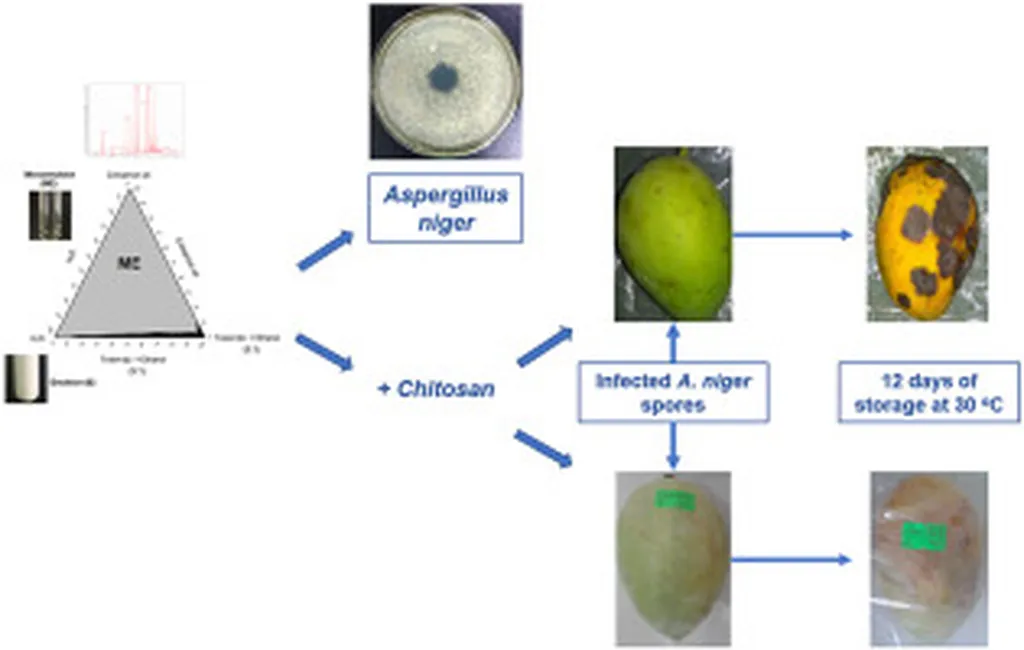
In the quest to extend the shelf life of mangoes, a team of researchers led by Zhiwei Wu from the Xinjiang Key Laboratory of Lavender Conservation and Utilization at Yili Normal University has made a significant breakthrough. Their study, published in *Food Chemistry: Molecular Sciences*, unveils the intricate molecular mechanisms behind how chitosan coatings delay the ripening of mango fruits, offering promising avenues for the agriculture sector.
Mangoes, being climacteric fruits, undergo rapid postharvest deterioration, which poses a substantial challenge for growers and distributors alike. Chitosan, a biopolymer derived from chitin, has long been recognized for its ability to extend the shelf life of fruits, but the precise molecular pathways involved have remained elusive. Wu and his team set out to change that.
By employing an integrative multi-omics approach—combining transcriptomics and metabolomics—the researchers were able to elucidate the complex interplay between chitosan and key ripening hormones like abscisic acid (ABA) and ethylene. “Our findings reveal that chitosan orchestrates a dual hormonal attenuation,” Wu explained. “It suppresses ABA biosynthesis and ethylene signaling while enhancing ABA catabolism.”
The study identified specific genes involved in these processes, such as NCED3 and ABA2 for ABA biosynthesis, and ETR1, EIN3/EIN4 for ethylene signaling. Additionally, the researchers found that chitosan treatment leads to the accumulation of γ-aminobutyric acid (GABA), which plays a crucial role in uncoupling starch-to-sugar conversion from ripening progression. This accumulation correlates with retained firmness and chlorophyll levels, key indicators of fruit quality and freshness.
One of the most intriguing findings was the identification of key transcription factors, WRKY53 and bZIP/RF2b, which are likely central hubs modulating ABA-ethylene crosstalk and cell wall integrity. “These transcription factors could be potential targets for developing targeted strategies to optimize postharvest preservation,” Wu suggested.
The commercial implications of this research are substantial. By understanding the molecular mechanisms behind chitosan’s effect on mango ripening, the agriculture sector can develop more effective and targeted preservation strategies. This could lead to reduced postharvest losses, extended shelf life, and improved fruit quality, ultimately benefiting both producers and consumers.
The study also opens up new avenues for research into other climacteric fruits, which share similar ripening mechanisms. “Our findings provide a foundation for future studies aimed at synchronously modulating ABA-ethylene crosstalk, GABA-mediated metabolic reprogramming, and key transcription factors,” Wu noted.
As the agriculture sector continues to grapple with the challenges of postharvest deterioration, this research offers a beacon of hope. By harnessing the power of integrative multi-omics analysis, scientists are uncovering the intricate molecular pathways that govern fruit ripening, paving the way for innovative solutions that can enhance food security and sustainability.