
In a groundbreaking development for the agriculture sector, researchers have harnessed the power of Near-Infrared Spectroscopy (NIRS) to rapidly and non-destructively predict key nutritional content in common bean seeds. This innovation, detailed in a recent study published in *Food Chemistry: Molecular Sciences*, opens new avenues for enhancing the nutritional value of one of the world’s most important legume crops.
Common beans (Phaseolus vulgaris L.) are a staple food for millions, particularly in Latin America and Africa, where they play a crucial role in food security and nutrition. However, the increasing demand for beans underscores the need to improve their nutritional profile through breeding programs. Traditionally, assessing nutrient content in seeds has been a time-consuming and destructive process, limiting the ability of breeders to quickly evaluate large and diverse germplasm collections.
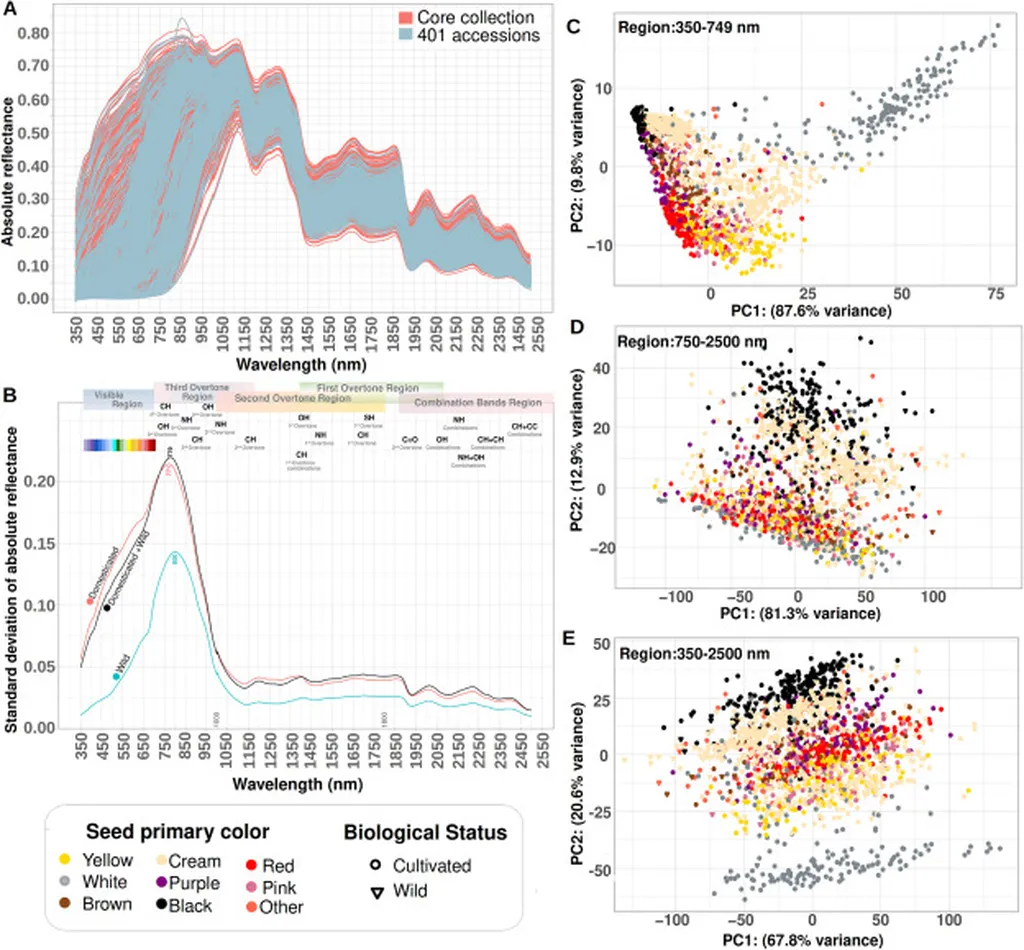
Enter Near-Infrared Spectroscopy (NIRS), a technology that offers a fast, cost-effective, and non-destructive method for predicting nutrient levels in intact seeds. In this study, researchers led by Tatiana Garcia from the Departamento de Agronomía at the Universidad Nacional de Colombia, Bogotá, developed predictive models using NIRS to estimate nitrogen (N), iron (Fe), and zinc (Zn) content in common bean seeds. The team analyzed spectra from 1754 accessions, both wild and domesticated, held at the International Center for Tropical Agriculture.
The results were promising. The predictive models achieved a concordance correlation coefficient (CCC) of 0.84 for nitrogen content, demonstrating high accuracy. For iron and zinc, the CCC was 0.4, indicating a moderate level of prediction. Notably, the study found that wild accessions had higher nitrogen content compared to domesticated ones, a finding that could guide future breeding efforts.
“This technology allows us to quickly and accurately assess the nutritional content of thousands of seed samples without destroying them,” said Garcia. “This is a game-changer for breeders who can now make more informed decisions about which seeds to use in their programs.”
The implications for the agriculture sector are significant. By enabling rapid and non-destructive nutrient analysis, NIRS can streamline the breeding process, accelerating the development of common bean varieties with enhanced nutritional profiles. This, in turn, can improve food security and nutrition for millions of people who rely on beans as a dietary staple.
Moreover, the ability to quickly evaluate large germplasm collections can uncover valuable genetic diversity that might otherwise go unnoticed. This could lead to the discovery of new traits and the development of more resilient and nutritious bean varieties.
As the global demand for beans continues to rise, the adoption of technologies like NIRS could revolutionize the way breeders and researchers approach crop improvement. By providing a faster and more efficient method for nutrient analysis, this innovation paves the way for a more sustainable and food-secure future.
In the words of Garcia, “This is just the beginning. The potential applications of NIRS in agriculture are vast, and we are excited to see how this technology will continue to shape the future of crop breeding and food security.”
With the study published in *Food Chemistry: Molecular Sciences* and led by Tatiana Garcia from the Universidad Nacional de Colombia, this research marks a significant step forward in the quest to enhance the nutritional value of common beans and improve food security worldwide.